
As a defense contractor familiar with CMMC, you’re likely encountering a flood of contradictory information about who can help you, what services you actually need, and whether you even need external assistance at all. The market for CMMC Services is saturated with consultants making conflicting claims or promising services they can’t legally provide, and well-meaning cybersecurity professionals who may not explain the critical distinctions between compliance preparation and certification assessment.
The confusion is understandable—CMMC involves multiple professionals with overlapping credentials but distinct roles, strict independence requirements that prevent certain organizations from providing both services to the same client, and a timeline that creates pressure to make decisions quickly. Adding to the complexity, many professionals hold multiple credentials (RP, RPA, CCP, CCA, etc.) but are restricted in how they can use these them depending on their organizational affiliations and client relationships.
This blog cuts through the confusion by clearly explaining who can legally help with what aspects of CMMC, when you need each type of professional, and why the same qualified expert cannot help you with both compliance preparation and certification assessment—even if they’re trained and authorized to do both. You need to ensure you have a partner that can help you avoid the common critical pitfalls and help you prepare for certification.
The Evolution from DFARS to CMMC: Why This Transition Matters
The DFARS self-attestation model under clause 252.204-7012 proved inadequate, with DoD audits finding only 10-15% actual compliance requirements were despite contractor self-reporting protocols. CMMC addresses these gaps by requiring third-party verification through authorized assessors and introducing a tiered approach based on information sensitivity.
How CMMC is Different
CMMC is fundamentally different from traditional compliance frameworks. It combines cybersecurity standards with a maturity model approach, creating a structured pathway for organizations to enhance their cybersecurity posture progressively. This framework recognizes that cybersecurity is not a destination but a journey of continuous improvement.
The model addresses three critical components that previous frameworks often treated separately: cybersecurity practices, processes, and people. This holistic approach ensures that organizations don’t just implement technical controls but also develop the organizational maturity necessary to maintain and evolve their cybersecurity posture over time.
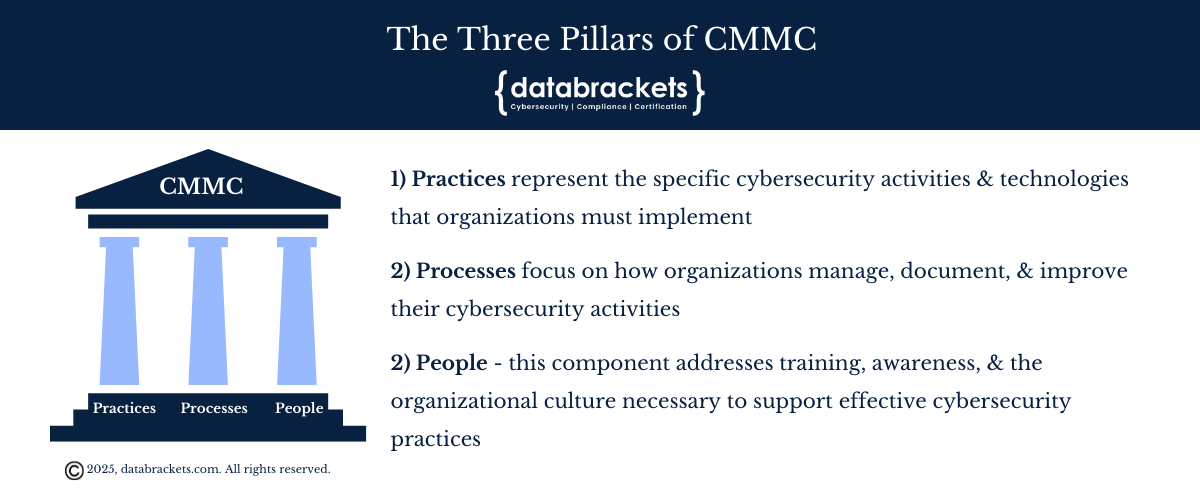
The Three Pillars of CMMC
Practices represent the specific cybersecurity activities and technologies that organizations must implement. These align closely with established frameworks like NIST SP 800-171 but are organized in a way that supports progressive implementation and maturation.
Processes focus on how organizations manage, document, and improve their cybersecurity activities. This includes everything from incident response procedures to risk management frameworks. The process component ensures that cybersecurity practices are sustainable and can evolve with changing threats.
People acknowledges that cybersecurity is ultimately a human endeavor. This component addresses training, awareness, and the organizational culture necessary to support effective cybersecurity practices. It recognizes that even the best technical controls can fail without proper human oversight and engagement.
CMMC Levels and Their Strategic Implications
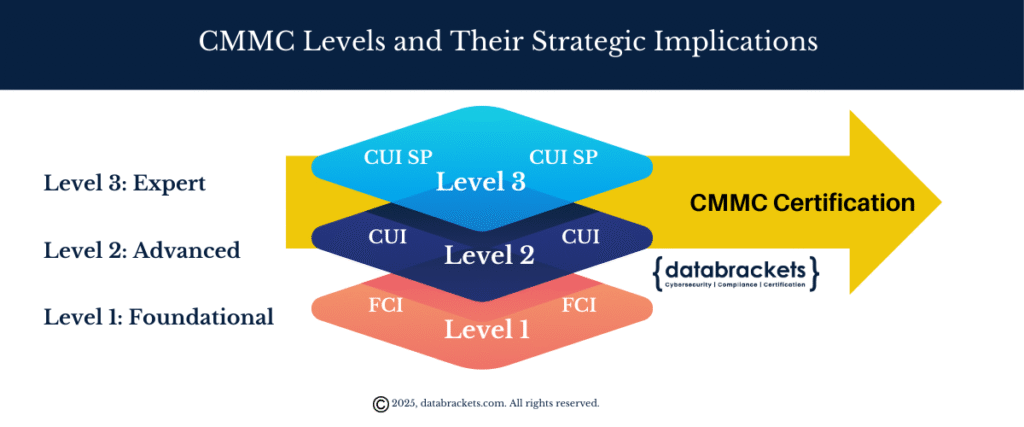
CMMC 2.0 streamlined the original CMMC five-level model into three levels, each aligned with specific types of information and risk profiles:
Level 1 (Foundational) focuses on protecting Federal Contract Information (FCI) and represents basic cyber hygiene practices. Organizations at this level demonstrate fundamental cybersecurity awareness and implement basic protective measures. While this might seem straightforward, many organizations discover gaps in their basic cybersecurity practices during assessment preparation.
Level 2 (Advanced) addresses the protection of Controlled Unclassified Information (CUI) and requires implementation of all 110 security controls from NIST SP 800-171. This level represents the majority of DoD contracting requirements and requires organizations to demonstrate both technical implementation and process maturity.
Level 3 (Expert) is designed for organizations handling the most sensitive unclassified information and requiring protection against Advanced Persistent Threats (APTs). This level includes 24 additional controls from NIST SP 800-172 and requires the highest level of process maturity and organizational capability.
Understanding which level applies to your contracts is crucial for strategic planning and resource allocation. Many organizations assume they need Level 2 certification when Level 1 might be sufficient for their current contracts, while others underestimate their requirements and find themselves unprepared for higher-level certifications.
The Critical Distinction between
CMMC Compliance and CMMC Certification
Understanding the fundamental difference between CMMC compliance and certification is essential for navigating the professional landscape and selecting appropriate service providers. These represent two distinct phases of your CMMC journey, each requiring different types of professionals with specific qualifications.
The timing distinction is crucial—you must achieve compliance before pursuing certification. Compliance preparation typically takes 6-18 months depending on your starting point, while the certification assessment itself takes 2-6 weeks. This sequential relationship means strategic planning is essential for meeting contract deadlines.
Perhaps most importantly, the same professionals cannot help the same client with both phases, even if they hold all the necessary credentials and training. This independence requirement prevents conflicts of interest and ensures objective assessment. A consultant who helps you implement security controls cannot later assess whether those same controls meet CMMC requirements. Similarly, a C3PAO that conducts your certification assessment cannot have previously provided implementation guidance to your organization and if you fail to meet a control requirement, they cannot guide you how to meet it.
During the compliance phase, several organizations prefer to work with professionals who are trained in both processes and can guide them about the type of evidence, documentation etc. that is expected during certification.
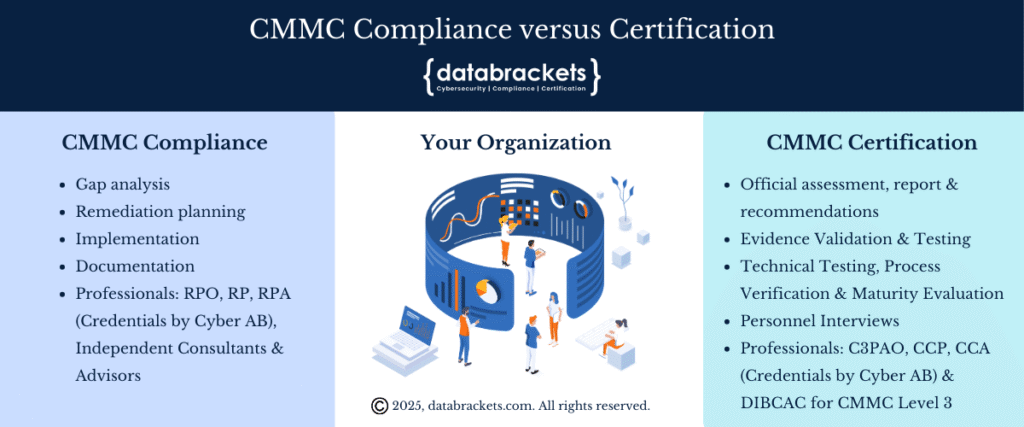
CMMC Compliance
The compliance phase represents the preparatory work necessary to implement CMMC requirements and achieve organizational readiness for certification assessment. This phase focuses on:
Gap analysis
Remediation planning
Implementation
Documentation development
During compliance preparation, organizations work to implement the necessary cybersecurity practices and processes defined in NIST SP 800-171 (for Level 1 & 2) and 24 additional controls of NIST SP 800-172 for Level 3. This phase includes both technical implementation and process development, creating the foundation that will eventually be assessed during certification.
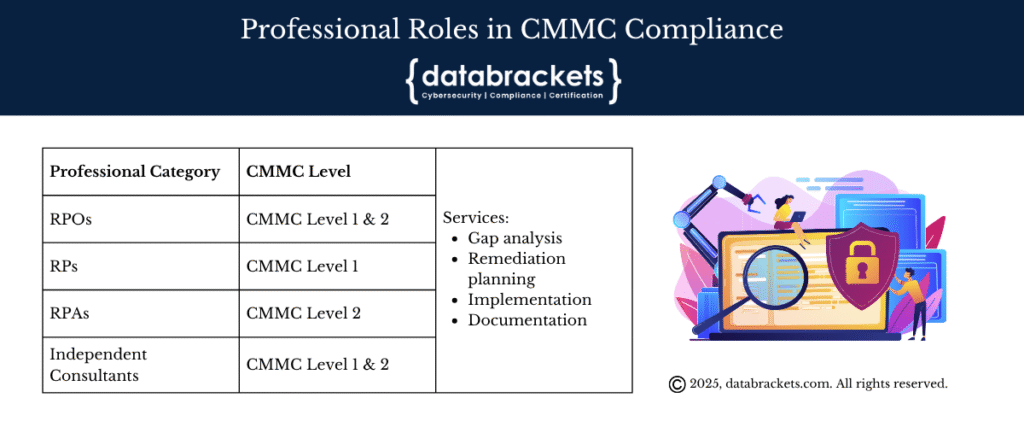
Professional Roles in CMMC Compliance
The CMMC compliance phase involves several categories of professionals, each with different standards, levels of qualifications, and accountability. Understanding these distinctions is essential for organizations building their CMMC strategy and selecting appropriate service providers for the preparation phase.
Registered Provider Organizations (RPOs) operate under formal standards and requirements from the CMMC Accreditation Body (CyberAB). Personnel within RPOs include Registered Practitioners (RPs) and Registered Practitioners – Advanced (RPAs), who hold individual credentials issued by CyberAB after completing required training programs. These professionals cannot conduct official certification assessments. Some RPAs also hold industry certifications such as CISSP, CISM, CISA, or experience with NIST frameworks.
RPOs must meet stringent qualification requirements and maintain ongoing compliance with program standards, providing CMMC compliance clients with assurance of quality and accountability that independent consultants cannot offer.
Authorized Services by RPOs: Gap analysis, remediation planning, implementation support, policy development, training, and hands-on technical assistance. The scope of RPO services includes everything necessary to prepare organizations for CMMC certification, from initial gap analysis through final readiness validation.
RPO Deliverables:
CMMC Readiness Assessment including gap analysis and remediation plans
Policy and procedure documentation
Implementation guides and training materials
Technical implementation support
RPO deliverables include comprehensive readiness assessments that evaluate organizational preparedness for formal CMMC assessment. These assessments provide detailed findings and recommendations for final preparation activities, backed by CyberAB’s formal standards and quality standards.
Implementation documentation prepared by RPOs includes policies, procedures, and technical configuration guides tailored to specific organizational needs and CMMC requirements. Training programs developed by RPOs address both technical implementation and process management aspects of CMMC compliance, ensuring organizational readiness extends beyond just technical controls.
Registered Practitioners (RPs) – CMMC Compliance Level 1
Registered Practitioners (RPs) are individual professionals who have completed CyberAB training and registration to provide CMMC compliance consulting services. They deliver all services required to meet Level 1 compliance requirements. RPs cannot provide services for CMMC Level 2 or higher, which require more specialized expertise.
RPs can work independently or as employees of RPOs, providing specialized expertise in CMMC preparation and implementation for Level 1 only. They must maintain their registration through ongoing education and compliance with CyberAB standards.
Registered Practitioner Advanced (RPA) – CMMC Compliance Level 2
Registered Practitioners – Advanced (RPAs) are authorized to provide more comprehensive services than standard RPs. They can assist organizations with the complex aspects of CMMC Level 2 compliance, including advanced security controls, sophisticated system architectures, and the detailed documentation and process requirements associated with protecting Controlled Unclassified Information (CUI). They provide comprehensive gap assessments, advanced remediation planning, complex policy development, specialized training, and detailed readiness validation for CMMC Level 2 requirements.
Important Limitations: Despite their advanced qualifications, neither RPs nor RPAs can conduct official CMMC assessments or issue certifications. These activities are reserved for CMMC Certified Assessors (CCAs) working within authorized C3PAOs during the certification phase.
Independent CMMC Consultants and Advisors
Independent CMMC consultants represent a broader category of compliance professionals. They typically possess extensive cybersecurity experience, often including backgrounds in information security, risk management, compliance, or related fields. Many hold industry certifications such as CISSP, CISM, CISA, or experience with NIST frameworks. Unlike RPOs, independent consultants are not required to hold specific CMMC credentials or meet CyberAB standards. This flexibility means clients must conduct their own due diligence regarding consultant qualifications and capabilities.
Services: Gap analysis, remediation planning, implementation support, policy development, training, and hands-on technical assistance with variable methodologies.
Key Deliverables:
Gap analysis reports and remediation plans
Policy and procedure documentation
Implementation guides and training materials
Technical implementation support
Clients need to be mindful that methodologies used may vary significantly between consultants.
CMMC Compliance Professionals – Timelines and Cost | ||
Professional Category | Timeline | Estimated Cost |
RPOs | 2-24 months | $10,000-$100,000+ |
RPs | 2-6 months | $3,000-$20,000 |
RPAs | 6-24 months | $30,000-$120,000+ |
Independent Consultants | 6-24 months | $35,000-$130,000+ |
Disclaimer: Timelines vary significantly based on organizational size, cybersecurity maturity, and complexity. Small organizations with basic requirements may achieve Level 1 compliance in 2-6 months, while Level 2 compliance typically requires 6-24 months for most contractors due to the 110 NIST SP 800-171 controls. Large enterprises or organizations with complex legacy systems may require extended timelines regardless of CMMC level. Costs depend on your current security posture, scope of remediation required, and whether internal resources or external consulting is used.
CMMC Certification: Third-Party Validation
The certification phase transforms months of compliance preparation into a formal evaluation that determines whether your organization can compete for defense contracts. Unlike self-directed compliance work, certification involves independent professionals who must maintain strict objectivity while validating your cybersecurity implementations. Certification is not a one-time event but an ongoing responsibility requiring maintenance of the organization’s cybersecurity posture between triennial assessments.
This high-stakes process operates through a carefully structured ecosystem where different professionals have distinct roles, specific deliverables, and absolute boundaries on what they can and cannot provide. While some CCPs and CCAs are allowed to offer consulting and compliance services, they are not authorized to offer them to a client whom they may be assessing for certification.
The Certification Ecosystem Structure
CMMC certification operates through a three-tier professional hierarchy designed to ensure qualified oversight while providing career advancement pathways. It consists of Lead CMMC Certified Assessors (Lead CCAs), CMMC Certified Assessors (CCAs), and CMMC Certified Professionals (CCPs).
Assessment Authority Flow:
Lead CCAs: Oversee entire assessment processes and team leadership
CCAs: Conduct full Level 1 & 2 assessments with final determination authority
CCPs: Support assessments by verifying Level 1 practices only under CCA supervision
Critical Independence Principle: All certification professionals are absolutely prohibited from providing compliance consulting, implementation guidance, or remediation services to organizations they assess. This separation ensures objective evaluation and prevents conflicts of interest. However, they can offer consulting and implementation to organizations that they do not assess for CMMC certification.
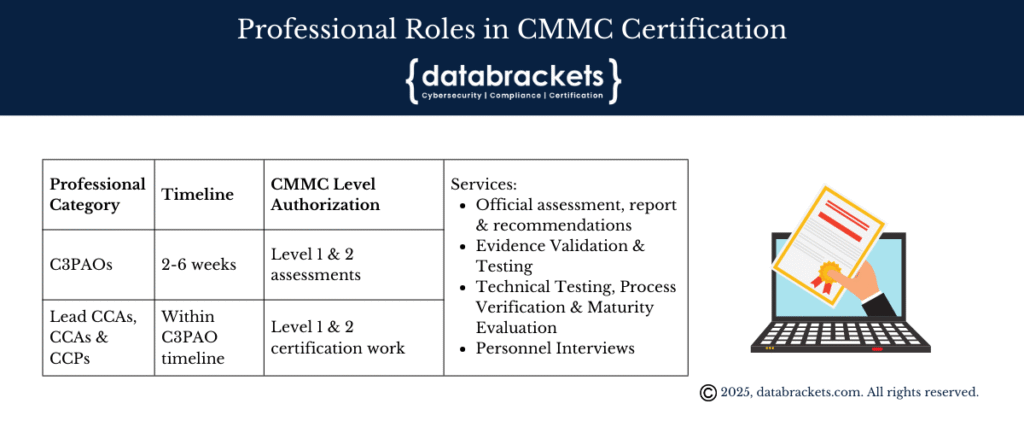
Professional Roles in CMMC Certification
CMMC Third-Party Assessment Organizations (C3PAOs)
C3PAOs represent the cornerstone of the CMMC certification ecosystem. These organizations are authorized to conduct official CMMC assessments and issue certifications. The C3PAO designation requires extensive qualification to ensure assessment quality and consistency.
Organizational Qualifications for C3PAOs: C3PAOs must demonstrate significant cybersecurity assessment experience, including experience with frameworks similar to CMMC. They must show proven capability in conducting complex cybersecurity assessments and managing multi-week engagement projects.
Quality management systems are mandatory for C3PAOs, including standardized assessment methodologies, quality control processes, and continuous improvement programs. These systems ensure consistent assessment quality across different engagement teams and time periods.
Personnel requirements include employing sufficient numbers of qualified CCAs to support the organization’s assessment volume. C3PAOs must maintain appropriate staffing levels and expertise areas to serve their client base effectively.
Overview of a C3PAO’s CMMC Assessment Team for Level 2
One Lead CCA (mandatory for team leadership)
At least one additional CCA (for assessment depth)
Optional CCPs for support roles under supervision
CMMC Quality Assurance Professional for validation
Assessment Methodology:
Interview: Personnel discussions across organizational hierarchy
Examine: Documentation review and evidence validation
Test: Technical control functionality verification
Certification Outcomes and Implications
Final Status: All 110 practices meet requirements – full certification achieved
Conditional Status: 80%+ score (88+ practices MET) with POA&M for non-critical gaps
Not Achieved: Below 80% score – certification denied, reassessment required
POA&M Restrictions:
Only available for non-critical controls (weights 1-2)
Critical controls (weights 3-5) must be fully implemented during assessment
180-day remediation timeline for conditional certification
C3PAO conducts focused closeout assessment after remediation
The certification ecosystem ensures objective evaluation while maintaining clear professional boundaries. Organizations must understand these roles and limitations to navigate the assessment process effectively and achieve successful CMMC certification.
C3PAO Deliverables
The primary deliverable from C3PAOs is the official CMMC assessment report, which documents assessment findings and supports certification decisions. This report becomes part of the official record for the organization’s CMMC certification.
Certification recommendations represent another key deliverable, with C3PAOs providing formal recommendations about whether organizations should receive CMMC certification based on assessment findings. These recommendations cannot include remediation measures if any critical control is not performing at the required maturity level. POA&M’s may be planned & implemented for non-critical controls before the certification is issued.
Primary Assessment Outputs:
Official CMMC assessment report documenting all findings and evidence
Final Findings Briefing summarizing MET/NOT MET status for each practice
Certification recommendations (Conditional, Final, or Not Achieved status)
Assessment results package submission to DoD’s eMASS system
Certificate of CMMC Status based on assessment outcomes
Can C3PAOs Explain Their Recommendations? Yes, C3PAOs are allowed and expected to explain their findings clearly and provide clear communication throughout the assessment process. However, there are strict limitations on what they can explain:
What C3PAOs CAN Explain:
Why specific practices were scored as MET or NOT MET
What evidence was insufficient or missing
Which controls are critical vs. non-critical
Assessment methodology and scoring rationale
What C3PAOs CANNOT Provide:
Specific remediation advice or guidance on how to fix deficiencies
Implementation recommendations for failed controls
Consulting services on how to resolve issues that disqualified certification
POA&M (Plan of Action & Milestones) Role: C3PAOs can
Identify which controls are eligible for POA&M placement
Explain the POA&M process and 180-day remediation timeline
Describe critical vs. non-critical control distinctions
Cannot provide: Specific remediation strategies or implementation guidance
Timeline: 2-6 weeks for complete assessment activities
Lead CMMC Certified Assessors (Lead CCAs)
Senior assessment professionals holding the highest tier of CMMC credentials, providing team leadership and oversight for complex evaluations.
Qualifications: Must hold CCA credentials in good standing, possess 5+ years cybersecurity experience, 5+ years management experience, 3+ years assessment/audit experience in leadership roles, and DoD certifications at Advanced Proficiency Level per Manual 8140.03 including credentials such as CISSP with relevant concentrations, SABSA, CISM with advanced specializations, or other expert-level certifications that demonstrate senior cybersecurity leadership competency.
Level Authorization: Level 1 & 2 assessment leadership with comprehensive team oversight authority
Leadership Responsibilities & Deliverables: Lead CCAs coordinate the entire assessment processes, ensure quality and consistency across assessment teams, provide technical leadership for complex scenarios including resolving complex issues, and serve as primary points of contact with C3PAO management.
Enhanced Deliverables:
Assessment team leadership and strategic coordination with assessed organizations
Senior oversight of complex technical evaluations
Final certification recommendations to C3PAO leadership
Quality assurance for comprehensive assessment processes
Mentorship and professional development of junior assessment team members
Resolution of complex assessment challenges and edge cases
Assessment appeals and dispute resolution leadership
Timeline: Responsible for overall 2–6-week assessment timeline management
CMMC Certified Assessors (CCAs)
CCAs are core assessment professionals holding credentials that authorize them to conduct full Level 2 evaluations and make final certification determinations.
Qualifications: Must first hold CCP credentials, demonstrate 3+ years cybersecurity experience and 1+ year assessment/audit experience, complete 3 assessments as team members under supervision, pass 150-question examination (4 hours, 500+ score required), and maintain favorable background investigations.
DoD Certification Requirements: CCAs must hold Department of Defense certifications per DoD Manual 8140.03 at the Intermediate Proficiency Level, which includes credentials like CISSP, CISM, GCIH, or other approved certifications that meet DoD cybersecurity workforce standards. These requirements ensure assessors possess recognized expertise beyond the basic CCP credential.
Level Authorization: Full Level 1 & 2 assessment authority with final determination capabilities
Timeline: Within C3PAO assessment timeline
CCA Responsibilities: CCAs possess the authority to make binding assessment decisions, lead portions of assessment activities, and serve as the primary interface between assessment teams and organizations seeking certification (OSCs).
CCA Deliverables:
Complete Level 1 & 2 practice assessments
Final scoring determinations and recommendations
Evidence validation and technical testing oversight
Personnel interviews and process evaluation
Comprehensive assessment documentation
CMMC Certified Professionals (CCPs)
They are entry-level assessment professionals with carefully defined participation boundaries in the certification process.
Qualifications: Must complete training through CyberAB-approved providers, pass a 170-question examination (3.5 hours, 500+ score required), hold a college degree in cybersecurity/IT field or demonstrate 2+ years equivalent experience, and maintain favorable Tier 3 background investigation for DoD assessments. They are also required to complete their CompTIA A+ certification or have equivalent knowledge or experience and complete DoD’s CUI Awareness Training.
Level Authorization: Level 1 self-assessments (independent) and Level 2 assessments (Level 1 practices only, under CCA supervision)
Key Limitation: CCPs cannot assess Level 2-specific practices or make final assessment determinations. They may only verify Level 1 practices during Level 2 assessments while working under direct CCA oversight, ensuring appropriate supervision while gaining practical experience.
CCP Deliverables:
Level 1 practice verification and documentation
Evidence collection support and organization
Assessment documentation assistance
Interview support and basic technical testing
Team member contributions under CCA supervision
Timeline: Embedded within C3PAO assessment schedule
Looking Forward: The Future of CMMC
The CMMC program continues to evolve, with ongoing refinements to requirements, processes, and implementation guidance. Organizations should stay current with program developments and maintain flexibility in their approach to CMMC compliance.
Future developments may include additional assessment options, refined requirements, and expanded scope. Organizations that build strong foundational capabilities will be better positioned to adapt to these changes.
The broader trend toward cybersecurity verification and third-party assessment extends beyond DoD contracting. Organizations that invest in CMMC capabilities may find these investments valuable for other regulatory requirements and business opportunities as well.
Key Takeaways
CMMC compliance and certification represent two distinct phases of a defense contractor’s cybersecurity journey, where compliance preparation builds the foundation that must be demonstrated before seeking formal certification.
The compliance phase focuses on implementing required cybersecurity practices, closing gaps, and developing supporting documentation so that an organization genuinely meets CMMC’s expectations before assessment.
Certification is an independent evaluation conducted by qualified professionals who are legally prohibited from providing the same organization’s compliance preparation, ensuring objectivity and preventing conflicts of interest.
Understanding the role distinctions among compliance consultants, certified assessors, and third-party assessment organizations helps organizations plan appropriately and select partners whose services fit each phase.
The compliance phase typically takes significantly longer than the certification assessment, requiring strategic planning to align readiness activities with contractual deadlines and avoid rushed execution.
Recognizing that compliance preparation and certification assessment require different expertise and timing supports smoother progress toward CMMC goals and reduces the risk of delays or rework during formal assessment.
How databrackets can help you with your CMMC Journey
databrackets is an authorized C3PAO and independent consulting organization for CMMC. We offer Certification OR Readiness and Consulting services for CMMC. To avoid a conflict of interest and abide by CMMC’s independence requirements, we do not offer both services to the same client.
We are an ideal partner for either service since we bring over 15 years of proven expertise in helping organizations achieve compliance or certification with the most rigorous cybersecurity and data privacy standards, including ISO 27001, SOC 2, HIPAA, NIST SP 800-53, NIST Cybersecurity Framework, NIST SP 800-171, GDPR, and CMMC. We are an authorized certifying body for ISO 27001 and 3PAO for FedRAMP.
Schedule a Consultation to work with us as your C3PAO for CMMC Certification or as your Compliance Partner to help you prepare for it.
A. Why Choose databrackets as your C3PAO
1. Proven Multi-Framework Expertise
What makes databrackets particularly valuable is our extensive experience across complementary frameworks, including NIST SP 800-171, NIST SP 800-53, SOC 2, ISO 27001, HIPAA, and NIST Cybersecurity Framework. We are also an authorized certifying body for ISO 27001 and 3PAO for FedRAMP.
This breadth of knowledge enables our assessment teams to understand how CMMC controls integrate with your existing compliance efforts and identify synergies that strengthen your overall security posture.
2. Technical Environment Proficiency
databrackets’ assessment team of CCAs and CCPs has the specialized technical competence essential for accurate CMMC evaluations. Our experience spans diverse technological environments, from traditional on-premises infrastructures to complex cloud deployments, ensuring we can effectively assess whatever technical landscape your organization operates in.
3. Strategic Timeline Management
With proven capability in managing sophisticated assessments spanning the typical 4–8-week timeframe, databrackets understands how to minimize disruption to your operations while ensuring comprehensive evaluation of all 110 NIST SP 800-171 security controls.
As a authorized C3PAO with extensive cybersecurity and compliance experience, databrackets offers a deep understanding of the CMMC assessment process. This comprehensive expertise enables us to conduct thorough assessments with clear explanations of findings and methodologies, resulting in more insightful evaluations for organizations seeking certification.
To inquire about our C3PAO Services, contact our team at sales@databrackets.com or schedule a free consultation.
B. Why Choose databrackets for Your CMMC Compliance Journey
We specialize in transforming CMMC compliance from a daunting obstacle into a strategic business enabler.
Proven Track Record: Over 14 years supporting organizations across diverse industries with complex compliance requirements
Comprehensive Approach: End-to-end support from initial assessment through ongoing compliance
Industry Recognition: Authorized certifying body for ISO 27001 and 3PAO for FedRAMP
Strategic Partnership: We don’t just help you achieve compliance—we help you leverage it for competitive advantage.
Our Comprehensive CMMC Compliance Services include:
1. Strategic Planning & Assessment:
CMMC readiness assessments and comprehensive gap analysis
CUI system boundary definition and scoping guidance
Network architecture documentation and CUI flow diagrams
Risk assessment and vendor compliance evaluations
2. Implementation & Documentation Support:
System Security Plan (SSP) development and customization
Complete policy and procedure documentation suite
FIPS validation documentation and shared control matrices
Evidence collection strategies and management systems
3. Assessment Preparation:
Mock assessments and readiness validation
CMMC documentation optimization and organization
Personnel training and assessment preparation
C3PAO coordination and selection support
4. Ongoing Compliance:
Continuous monitoring and compliance maintenance
Annual affirmation support and triennial assessment preparation
Change management and configuration control guidance
Customized CUI awareness training programs
For immediate assistance with your CMMC compliance journey, contact our certified experts at sales@databrackets.com or schedule a free consultation.
Helpful Resources:
Summary
To summarize,
This blog explains the important distinction between CMMC compliance preparation and formal certification assessment, emphasizing that they are separate phases in an organization’s cybersecurity journey.
CMMC compliance refers to the preparatory work required to implement mandated practices and processes, build documentation, and position the organization for assessment readiness.
Certification is the formal evaluation conducted by authorized assessors who are legally prohibited from providing compliance preparation to the same client, ensuring an objective and independent validation of adherence to CMMC requirements.
Understanding the roles and restrictions of different professionals involved in the process helps organizations plan appropriately and avoid conflicts of interest that could delay readiness or jeopardize certification outcomes.
The blog highlights that certification typically takes significantly less time than the compliance phase, reinforcing the need for strategic planning and early engagement of qualified partners for each phase.
Recognizing that compliance preparation and certification assessment are distinct and sequential supports smoother progress toward CMMC goals and reduces the risk of costly rework or delays during formal evaluation.
