
The FedRAMP Certification Bottleneck That Could Cost Your Organization Millions
You are months into your FedRAMP certification journey. Your System Security Plan is done. Your controls are mapped. You have a sponsoring agency waiting. Then the FedRAMP Penetration Testing phase arrives, and everything stalls.
For too many Cloud Service Providers, the FedRAMP penetration test is where timelines collapse, budgets balloon, and federal contracts slip out of reach. A failed or inadequate test does not just mean a minor setback. It means a 6-12-month delay to your Authority to Operate (ATO), millions in deferred revenue, and a remediation cycle that starts from scratch. All this, while the federal cloud market stays locked behind a door your organization cannot open.
The painful truth is that most of these failures are preventable. They happen because CSPs arrive at the penetration test under-informed about what is actually required: the six mandatory attack vectors that must be tested, why all testing must happen in your production environment, why only an accredited Third-Party Assessment Organization (3PAO) can conduct this test, and how the sweeping FedRAMP 2026 changes — including notices published on February 25, 2026 — affect your path to FedRAMP certification.
What Is FedRAMP Penetration Testing?
FedRAMP penetration testing is a mandatory, formally authorized, and structured simulated cyberattack conducted against your organization’s live production cloud environment. Its purpose is to determine whether real-world attackers could bypass your security controls — and to generate the documented evidence that authorizing officials need to make risk-informed FedRAMP certification decisions.
Unlike a standard commercial penetration test, FedRAMP penetration testing operates under a precise, non-negotiable set of requirements defined by the FedRAMP Program Management Office (PMO) in the FedRAMP Penetration Test Guidance (Version 3.0, June 30, 2022). These requirements exist because the data your platform will handle belongs to federal agencies and, ultimately, to the American public.
Can Only a 3PAO Conduct Your FedRAMP Penetration Test?
Yes — and this is one of the most important facts your organization needs to understand before planning your FedRAMP certification timeline.
FedRAMP penetration testing must be performed exclusively by an accredited Third-Party Assessment Organization (3PAO). A 3PAO is an independent organization that has been formally recognized by the FedRAMP PMO and holds the required accreditation — typically ISO/IEC 17020:2012 from the American Association for Laboratory Accreditation (A2LA) — demonstrating its competency to conduct FedRAMP security assessments. You can find authorized 3PAOs on the FedRAMP Marketplace.
A commercial penetration testing firm, regardless of technical capability, does not satisfy the FedRAMP penetration testing requirement unless it is an accredited 3PAO. The 3PAO requirement exists to ensure consistency, independence, and accountability in the assessment process. The findings and Security Assessment Report produced by the 3PAO are the evidence on which your authorizing official bases the FedRAMP certification decision. There are no substitutes and no exceptions.
Additionally, FedRAMP guidance specifies that the penetration test team lead must hold an industry-recognized credential for FedRAMP penetration testing, with qualifications meeting the requirements defined in the R311 FedRAMP: Specific Requirements document.
What Makes FedRAMP Penetration Testing different from a Standard Pen Test?
Production environment only: Testing must occur in your live production environment. Staging, development, or sandbox environments are explicitly prohibited as substitutes.
Six mandatory attack vectors: FedRAMP specifies six specific attack categories that must be tested on every Moderate and High impact system — no vector may be omitted without documented justification reviewed by the Authorizing Official.
MITRE ATT&CK mapping required: All findings must be mapped to the MITRE ATT&CK framework, standardizing how adversary tactics, techniques, and procedures are reported and interpreted.
Strict timing windows: Your initial FedRAMP penetration test must be completed no more than six months before your Security Assessment Report (SAR) submission. Annually thereafter to maintain your FedRAMP certification.
Comprehensive documentation: The 3PAO must produce a formal Security Assessment Report meeting FedRAMP’s documentation standards, which becomes part of your FedRAMP certification package.
The regulatory anchor for this requirement is NIST Special Publication 800-53, Control CA-8 (Penetration Testing). FedRAMP operationalizes CA-8 through the Penetration Test Guidance document, available at:
FedRAMP Penetration Test Guidance (fedramp.gov)
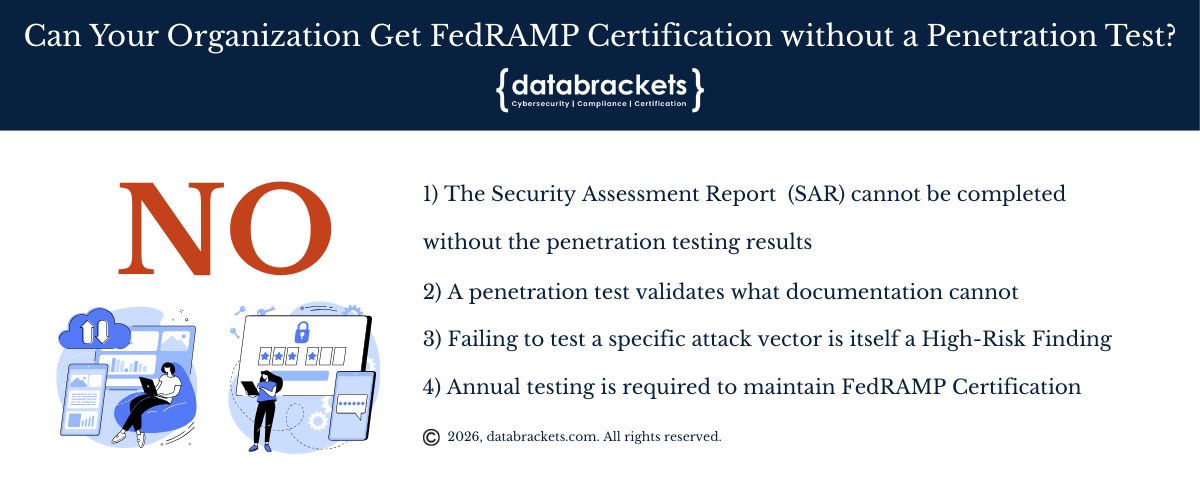
Can Your Organization Get FedRAMP Certification Without a Penetration Test?
No. There is no pathway to FedRAMP certification — whether an agency-issued Authority to Operate (ATO) or a Provisional ATO from the FedRAMP Board — without a completed and satisfactory 3PAO-conducted penetration test. This is not a procedural formality that can be waived, substituted, or deferred. Here is precisely why.
1. The SAR Cannot Be Completed Without Penetration Test Results
The Security Assessment Report (SAR) that authorizing officials use to make their FedRAMP certification decision depends on penetration test findings. There is no SAR template, no agency playbook, and no FedRAMP process that permits its completion without penetration test results from an accredited 3PAO. No SAR means no ATO. The dependency is absolute.
2. A Penetration Test Validates What Documentation Cannot
Your System Security Plan tells an authorizing official what security controls your organization says it has implemented. A penetration test tells them whether those controls actually hold under real attack conditions. The distinction is fundamental when the system being authorized will store, process, or transmit sensitive federal data. Narrative documentation, however thorough, cannot substitute for evidence of real-world resilience.
3. Failing to Test a Specific Attack Vector Is Itself a High-Risk Finding
FedRAMP guidance is explicit: if a specific attack vector cannot be performed, the deviation must be documented in the SAR, and the 3PAO may record non-conformance as a High-risk finding in the SAR Risk Exposure Table. Any deviation from the penetration testing guidance requires review and approval by the Authorizing Official and can independently delay your FedRAMP authorization process.
4. Annual Testing Is Required to Maintain FedRAMP Certification
FedRAMP certification is not a one-time credential. Your organization must maintain it through continuous monitoring, which requires annual penetration testing — every 12 months unless an authorizing official has approved an alternative with documented rationale. An ATO without ongoing FedRAMP penetration testing compliance is an ATO at risk of suspension.
The Federal Market Is Worth the Investment
The U.S. federal cloud services market is a significant and growing opportunity. Civilian federal agencies alone requested over $8.3 billion in cloud spending in FY2025 — more than double what was spent in FY2020 — and that figure excludes defense and intelligence agency cloud investment entirely. FedRAMP certification is the gateway credential for accessing that market. Viewed in this context, the penetration test is not a cost — it is an investment in a significant, recurring revenue opportunity that your organization cannot access without it.
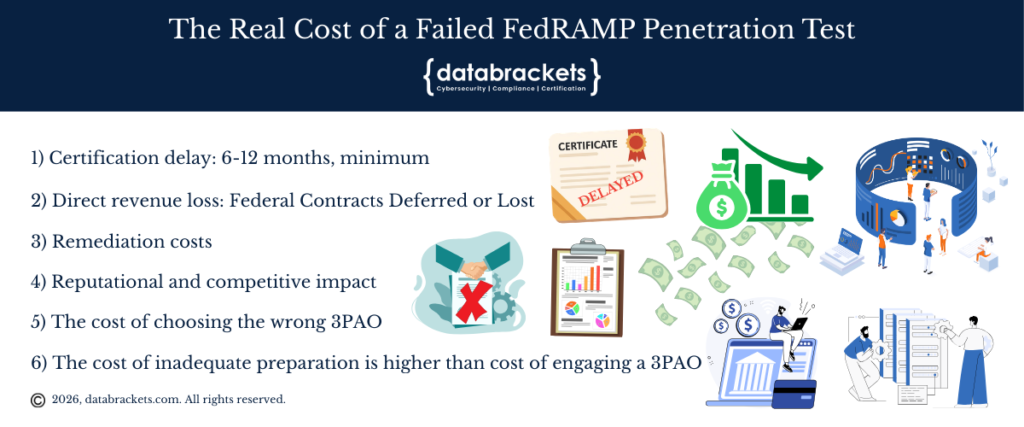
The Real Cost of a Failed FedRAMP Penetration Test
The consequences of a failed or inadequate FedRAMP penetration test extend well beyond a delayed report. They cascade across your organization’s timeline, budget, team capacity, and competitive position in the federal market. Understanding the full scope of that cost is essential before your organization enters the assessment process.
1. Certification Delay: 6-12 Months, Minimum
When a FedRAMP penetration test reveals High or critical findings, your organization must remediate before the authorization process can proceed. Remediation is followed by retesting, which requires coordination with your 3PAO, revised documentation, and resubmission of your certification package. In practice, this cycle adds a minimum of six months to your FedRAMP certification timeline — and twelve months or more when remediation is complex or when multiple High findings require resolution.
2. Direct Revenue Loss: Federal Contracts Deferred or Lost
Every month of certification delay is a month that your organization cannot win new federal contracts, cannot fulfill federal agency commitments that are contingent on FedRAMP certification, and cannot compete against FedRAMP-authorized competitors in federal procurement. For CSPs targeting the federal market, typical federal contract values mean that a single year of delay can represent millions of dollars in foregone revenue.
3. Remediation Costs
Remediation following a failed FedRAMP penetration test involves more than patching a vulnerability. Depending on the nature of the findings, your organization may need to re-architect components of your system, implement additional security controls, retrain personnel (particularly following a failed phishing simulation), update your System Security Plan, and engage your 3PAO for retesting. Each of these activities consumes engineering time, security team bandwidth, and budget that was not originally allocated for the assessment phase.
4. Reputational and Competitive Impact
In the federal market, FedRAMP certification status is visible. Agencies consult the FedRAMP Marketplace when evaluating cloud solutions, and a delayed or paused authorization process is visible to competitors and to the agencies your organization is pursuing. The reputational cost of a prolonged, failed assessment process can undermine your organization’s credibility with the very agencies you are seeking to serve.
5. The Cost of Choosing the Wrong 3PAO
A technically sound penetration test that fails to meet FedRAMP’s specific documentation requirements — because the performing firm lacks FedRAMP 3PAO experience — does not satisfy the requirement. Your organization will have paid for a test that cannot be submitted, and will need to commission a new one from a qualified 3PAO. This error alone can cost organizations months and tens of thousands of dollars in redundant assessment fees.
6. The Cost of Inadequate Preparation is higher than cost of engaging a 3PAO
The cost of inadequate preparation for a FedRAMP penetration test is, in virtually every case, significantly higher than the cost of engaging the right 3PAO, conducting a proper readiness assessment, and entering the formal test in a strong security posture. Organizations that treat the penetration test as a genuine security exercise — not a checkbox — consistently achieve better outcomes in less time and at lower total cost.

The Six Mandatory FedRAMP Attack Vectors
FedRAMP’s Penetration Test Guidance (Version 3.0) specifies six attack vectors that must be evaluated for all Moderate and High impact systems. Each vector simulates a distinct, realistic threat scenario. Together, they ensure that your security posture is tested from every relevant angle — not just the perimeter.
Given below is an overview, followed by a detailed breakdown of each vector and what your organization needs to prepare.
Attack Vector | What It Tests | CSP Impact if Missed |
External Network Attack | Unauthenticated internet-based attacks on all external-facing assets | Core perimeter weaknesses remain undetected and unaddressed |
External-to-Corporate (Phishing) | Social engineering campaigns targeting your admins and privileged users | Human error — the #1 breach vector — goes untested |
Web Application — Infrastructure | Authenticated users attempting to compromise underlying servers | Application-layer privilege escalation paths remain open |
Tenant-to-Tenant(Lateral Movement) | One tenant attempting to access another tenant’s data | Multi-tenant data isolation failures — a critical breach scenario |
Internal Network Attack | Insider threat and lateral movement within the authorization boundary | East-west control failures; potential total network compromise |
Client-side Application / Agents | Client-installed software and agents used to attack the target system | Client-side attack vectors ignored; endpoint-borne compromise risk |
Vector 1: External Network Attack — Unauthenticated External Access
The 3PAO operates as an unauthenticated attacker on the public internet, conducting active reconnaissance, vulnerability scanning, and manual exploitation attempts against all internet-facing components within your authorization boundary. This includes external IP addresses, hostnames, URLs, open ports, and any exposed services.
Your organization should provide the 3PAO with both IP addresses and hostnames. Many cloud environments use dynamic IP addressing, which can change during testing. Hostnames and URLs ensure the assessment targets your correct assets throughout the engagement.
Vector 2: External-to-Corporate Attack — Social Engineering and Phishing
This vector tests the human element of your security posture. The 3PAO conducts simulated phishing campaigns targeting your system administrators and personnel with privileged access to the FedRAMP authorization boundary. Critically, FedRAMP guidance requires that phishing simulation emails be allowed through your organization’s email security filters during testing, to accurately simulate what happens when a real attack reaches your administrators’ inboxes.
The updated FedRAMP Penetration Test Guidance expanded this vector beyond credential-harvesting email attacks. Testing scenarios can now include phishing payloads involving script execution or file delivery, reflecting the sophistication of modern spear-phishing campaigns.
Ensure that your privileged administrators are not using the same accounts for routine daily tasks (such as reading email) as they use for managing the production environment. Account separation is a straightforward control that significantly limits the impact of a successful phishing attempt.
Vector 3: Web Application Attack — Authenticated Infrastructure Compromise
Acting as an authenticated, legitimate user of your application, the 3PAO attempts to pivot from the application layer to the underlying servers and infrastructure. This tests whether application-layer access to your system can be exploited to compromise the underlying environment — a frequent pathway in real-world breaches of cloud platforms.
Ensure that accounts for each available user role within your application are provisioned for the 3PAO before testing begins. If your application allows self-registration, this path can supplement provisioned accounts.
Vector 4: Tenant-to-Tenant Attack — Lateral Movement Between Tenants
This vector is particularly critical for multi-tenant SaaS providers. The 3PAO, acting as a legitimate authenticated user in one tenant environment, attempts to access or compromise a separate tenant instance within your system. FedRAMP requires this testing to occur in your live production environment using two full production customer tenants with access methods that mirror those used by your actual customers.
Development or staging environments cannot be substituted here. The assessment evaluates authentication, data access controls, user permissions, and session management across your tenant boundaries, including vertical and horizontal privilege escalation attempts.
Vector 5: Internal Network Attack — Insider Threat and Lateral Movement
Simulating an insider threat or a compromised internal foothold, this vector evaluates an attacker’s ability to move laterally within your authorization boundary, escalate privileges, and access sensitive data. This is where your network segmentation controls, east-west traffic restrictions, and internal access controls are stress-tested.
A poorly secured domain controller during this phase can result in findings indicating potential total control of your network — one of the most severe findings possible in a FedRAMP assessment. Organizations should ensure network segmentation is rigorously enforced before entering this phase of testing.
Vector 6: Client-side Application and/or Agents Attack
This vector, introduced in the Version 3.0 guidance update, evaluates the security of client-installed software, agents, and similar components that interact with your cloud system. The 3PAO uses client-side applications or installed agents to attempt attacks against the target cloud system, testing for vulnerabilities in the client-to-cloud attack surface that internet-based testing does not cover.
This vector replaced the deprecated “Corporate to CSP Management” vector from the previous guidance, reflecting the evolution of how modern cloud systems are accessed and administered.
The FedRAMP Penetration Testing Process
FedRAMP penetration testing follows a structured, five-phase methodology. Understanding the full sequence helps your organization prepare effectively, coordinate with your 3PAO, and avoid the delays that most often arise from incomplete preparation before the engagement begins.
Phase | Key Activities | Primary Outputs |
1. Scoping | Define authorization boundary; identify in-scope components; finalize Rules of Engagement (ROE) | Security Assessment Plan (SAP), Authority to Test (ATT) |
2. Discovery | Reconnaissance, OSINT, vulnerability scanning, service enumeration | Asset inventory, open port lists, initial vulnerability map |
3. Exploitation | Manual and automated exploitation across all six attack vectors in production | Proof-of-concept documentation, MITRE ATT&CK TTP mappings |
4. Post-Exploitation | Privilege escalation, lateral movement, data exfiltration simulation | Attack chain narratives, full impact assessments |
5. Reporting | Risk-rated findings, remediation recommendations, SAR preparation | Security Assessment Report (SAR), POA&M input |
Most Problems Originate in Phase 1: Scoping
Before a single test is run, the authorization boundary must be precisely defined. The Security Assessment Plan (SAP) documents the testing methodology, timeline, and attack vectors. The Rules of Engagement (ROE) — developed in accordance with NIST SP 800-115 Appendix B and approved by the Authorizing Official before testing begins — define the systems in scope, testing constraints, schedules, and the boundaries within which the 3PAO is authorized to operate.
The Authority to Test (ATT) is the formal written authorization for testing to proceed. No FedRAMP penetration testing activities may begin without a signed ATT.
Experienced 3PAO teams consistently identify imprecise boundary definition as the leading cause of penetration test complications. Omitting components from the scope creates gaps that authorizing officials will flag. Allowing scope to drift into third-party or cloud provider infrastructure creates legal complications that FedRAMP guidance explicitly warns against. Invest time in getting scoping right.
Documentation Lifecycle Checklist
A common misconception is that all documents associated with a FedRAMP penetration test must be prepared by the Cloud Service Provider (CSP) before the Third Party Assessment Organization (3PAO) arrives. In reality, these documents span three distinct phases. Some are prerequisites the CSP must have ready in advance, one is developed collaboratively during planning, and others are produced as outputs after testing concludes. The checklist below organizes each document by phase, so responsibilities are clear.
Phase 1 — Pre-Assessment: CSP Must Have Ready Before Testing Begins
System Security Plan (SSP): Must be complete and current before any testing starts. The 3PAO uses it as the authoritative baseline against which all controls are assessed.
Rules of Engagement (ROE): A signed agreement — executed by both the CSP and 3PAO — defining testing scope, constraints, authorized attack vectors, and notification requirements. No testing may begin without it.
Authority to Test (ATT): Formal written authorization from the CSP granting the 3PAO explicit permission to conduct testing. This provides the legal basis for the engagement.
Phase 2 — Assessment Planning: Developed Collaboratively with the 3PAO
Security Assessment Plan (SAP): Drafted by the 3PAO in coordination with the CSP, defining the methodology, timeline, and specific test cases. The CSP reviews and approves it, but does not produce it unilaterally.
Phase 3 — Post-Assessment: Produced After Testing Concludes
Security Assessment Report (SAR): The 3PAO’s formal findings report, including MITRE ATT&CK mappings, risk ratings, and remediation recommendations. This is delivered to the CSP after testing — the CSP does not prepare it.
Plan of Action and Milestones (POA&M): Created by the CSP in response to findings in the SAR. It tracks unresolved vulnerabilities, remediation timelines, and responsible owners. It cannot exist until the SAR identifies what needs to be addressed.
Understanding Risk Ratings and the Plan of Action and Milestones
Every vulnerability discovered during your FedRAMP penetration test receives a risk rating based on its severity and exploitability. The rating directly influences the FedRAMP certification decision and the urgency of your remediation obligations. FedRAMP uses a three-tier risk rating system aligned with NIST guidelines:
High Risk Level implies an Immediate risk of unauthorized data access, disclosure, or manipulation. It requires rapid remediation and is heavily scrutinized by authorizing officials. It can delay or block ATO.
Moderate Risk Level implies meaningful risk requiring additional conditions to exploit. It must be addressed within defined remediation windows and tracked in your POA&M.
Low Risk Level implies limited exploitability or impact under realistic conditions. Even though it has a lower urgency, it must be tracked and resolved within standard timelines.
All findings that are not remediated before certification are documented in your Plan of Action and Milestones (POA&M). The POA&M is a living document maintained throughout the continuous monitoring phase, demonstrating to federal agencies that your organization is actively managing identified risks.
High-severity findings receive particular scrutiny from authorizing officials. Their presence does not automatically preclude FedRAMP certification, but they require a detailed explanation of any compensating controls in place and a credible, time-bound remediation plan. Authorizing officials are looking for evidence of accountability and active risk management — not perfection.
The 2026 FedRAMP Landscape: What Changed and What It Means for Your Organization
FedRAMP is in the midst of its most significant transformation since the program’s founding. The 2026 changes are not incremental adjustments. They represent a fundamental rethinking of how FedRAMP authorization works, how FedRAMP Certifications are designated, and how cloud service providers will demonstrate continuous security compliance in the future. Your organization needs to understand these changes to plan your FedRAMP authorization path effectively.
The February 25, 2026, FedRAMP Public Notices
On February 25, 2026, FedRAMP published two significant Public Notices as initial outcomes from Requests for Comment that closed in February 2026. These notices carry direct implications for every CSP navigating the FedRAMP authorization process.
NTC-0004: New FedRAMP Certification Designations (Outcome of RFC-0020)
The single official label for all FedRAMP authorizations will become FedRAMP Certification or FedRAMP Certified. This change is grounded in the FedRAMP Authorization Act, which defines a FedRAMP authorization as a certification that a cloud computing product or service has completed a FedRAMP authorization process. Importantly, based on public comment, FedRAMP confirmed that there will NOT be separate designations for the 20x and Rev5 paths (earlier proposed labels such as “FedRAMP Validated” for 20x were rejected). Both paths will carry the same “FedRAMP Certified” designation, with marketplace filters distinguishing them.
FedRAMP is also moving to a class-based assessment baseline. The new baseline classes are:
Class A: A new pilot baseline
Class B: Encompassing the current Li-SaaS and Low baselines
Class C: Corresponding to the current Moderate baseline
Class D: Corresponding to the current High baseline
The full Consolidated Rules for 2026 (CR26) will be published by the end of June 2026 and will remain valid through December 31, 2028.
Read the full notice:
NTC-0004: Initial Outcome from RFC-0020 FedRAMP Authorization Designations (fedramp.gov)
NTC-0005: Expanding the FedRAMP Marketplace (Outcome of RFC-0021)
FedRAMP confirmed it will not publish pricing information for cloud services, independent assessors, or advisory services on the Marketplace — a proposal that drew significant pushback during the public comment period. The Marketplace expansion will instead focus on transparency around service capabilities and FedRAMP authorization status. A JSON schema for web information requirements for independent assessors and advisory services will be included in the Consolidated Rules for 2026.
Read the full notice:
NTC-0005: Initial Outcome from RFC-0021 Expanding the FedRAMP Marketplace (fedramp.gov)
FedRAMP 20x: The Modernization Program Reshaping Everything
FedRAMP 20x is the program’s most ambitious modernization initiative, replacing the traditional documentation-heavy FedRAMP Rev5 authorization model with a continuous, automation-driven compliance approach built around Key Security Indicators (KSIs) and machine-readable evidence.
The 20x program does not eliminate the FedRAMP penetration testing requirement. It focuses heavily on automation and “machine-readable” evidence to replace manual documentation, and treats penetration testing as a critical, non-automated validation component.
Phase 1 (Completed September 2025): The 20x Low Pilot accepted 26 submissions and granted 12 initial pilot FedRAMP Certifications, proving the feasibility of automation-based assessment.
Phase 2 (Active through March 31, 2026): The 20x Moderate Pilot is live working toward FedRAMP Certification at the Moderate baseline through the 20x framework.
Phase 3 (FY26 Q3–Q4 — approximately July–September 2026): Wide-scale adoption of 20x for both Low and Moderate CSPs. Once Phase 3 opens, the federal cloud market becomes substantially more accessible to modern cloud-native organizations.
Phase 4 (FY27 Q1–Q2): FedRAMP will pilot a 20x path for High impact FedRAMP Certifications.
Phase 5 (FY27 Q3–Q4): FedRAMP aims to stop accepting new Rev5-based agency authorizations.
Explore the 20x roadmap: FedRAMP 20x Overview (fedramp.gov)
Significant Change Notifications: Greater Agility for Rev5 CSPs
The FedRAMP Board voted to support wide-scale adoption of the Significant Change Notifications (SCN) process for Rev5 providers. The SCN process shifts from the old “ask permission before making changes” Significant Change Request model to a “notify with proper documentation” approach. The goal is for the majority of Rev5 CSPs to adopt this process by the end of 2026, providing greater agility in deploying updates without the delays of the old approval cycle — while maintaining strict change management and risk discipline.
Machine-Readable Certification Packages (RFC-0024)
FedRAMP Rev5 providers will be required to produce machine-readable FedRAMP Certification packages consumable by agency tools. The initial compliance deadline is September 30, 2026, with a final deadline of September 30, 2027. Organizations that do not meet the final deadline will have their FedRAMP Certification revoked. Your organization should begin planning for this requirement now as it fundamentally changes how FedRAMP Certification evidence is packaged and shared.
FedRAMP’s public roadmap and all open Requests for Comment can be tracked at:
FedRAMP.gov Changelog and Notices
FedRAMP.gov Public Notices
Common FedRAMP Penetration Testing Mistakes CSPs Make
The following are the most frequently observed and most preventable mistakes specific to the FedRAMP penetration testing process — not general FedRAMP compliance errors, but errors that occur in the planning, scoping, and execution of the penetration test itself. Each one has caused real organizations real delays.
Pen Testing Mistake 1: Substituting a Non-Production Environment
This is the most fundamental error in FedRAMP penetration testing. Some organizations, concerned about disrupting live services, attempt to use a staging or development environment in place of production. FedRAMP’s Penetration Test Guidance is unambiguous: testing must occur in your production environment. Staging environments are rarely identical to production and cannot validly represent your actual security posture. Your 3PAO is required to document this as a non-conformance finding, and the test will need to be repeated in production. This mistake alone can add months to your FedRAMP certification timeline.
Pen Testing Mistake 2: Failing to Prepare Your Organization for the Phishing Vector
Many CSPs invest heavily in network and application security preparation while underestimating the social engineering vector. FedRAMP requires that simulated phishing emails be allowed through your email security filters — your administrators will face realistic attack conditions, with no safety net. Organizations that have not conducted regular, realistic phishing awareness training for privileged users arrive at this vector unprepared. The findings can be severe and are visible to your authorizing official.
Pen Testing Mistake 3: Imprecise Authorization Boundary Definition Before Testing Begins
If your authorization boundary is not precisely defined in the Security Assessment Plan before testing begins, your FedRAMP penetration test may miss in-scope components or inadvertently extend to third-party infrastructure — creating both compliance gaps and legal complications. FedRAMP guidance explicitly requires that penetration testing consider the legal ramifications of testing in environments involving third-party services. The boundary definition must be finalized and agreed upon before the 3PAO begins any testing activity.
Pen Testing Mistake 4: Entering the Test With Known, Unaddressed High Vulnerabilities
Some organizations treat the FedRAMP penetration test as the mechanism for discovering all their vulnerabilities. The more effective approach is to conduct an internal security assessment or formal readiness review before the 3PAO engagement begins, identifying and remediating obvious gaps in advance. Entering the formal FedRAMP penetration test with known, unaddressed High vulnerabilities adds unnecessary remediation cycles, retesting costs, and timeline delays to your FedRAMP authorization process.
Pen Testing Mistake 5: Selecting a Penetration Testing Firm That Is Not a 3PAO
A technically skilled penetration testing firm without FedRAMP 3PAO accreditation cannot satisfy the FedRAMP penetration testing requirement. Your organization will have invested in a test that produces no usable FedRAMP evidence and will need to commission a new engagement from an accredited 3PAO. Beyond the credential issue, firms without FedRAMP-specific experience may produce technically sound findings but fail to meet the SAR documentation standards, MITRE ATT&CK mapping requirements, and ROE format that FedRAMP certification packages demand.
Pen Testing Mistake 6: Missing the Annual FedRAMP Penetration Testing Window
Once FedRAMP authorized, organizations sometimes treat ongoing penetration testing as a lower priority than the initial certification effort. Missing the annual testing window — or producing an inadequate annual assessment — puts your FedRAMP certification at risk of suspension. Build the annual penetration test into your operational calendar as a planned, non-negotiable activity with lead time for 3PAO scheduling, scoping, and testing.
Pen Testing Mistake 7: Omitting a Vector Without Proper Justification
If your organization believes a specific attack vector cannot be safely tested in your production environment, you cannot simply skip it. The deviation must be formally documented in the SAR, and the 3PAO may record non-conformance as a High-risk finding in the Risk Exposure Table. Any deviation requires review and agreement from your Authorizing Official. This additional review process adds time to your FedRAMP certification and is never a shortcut.
Choosing the Right 3PAO Partner for FedRAMP Penetration Testing
Your 3PAO is not just a vendor — it is a critical partner in your FedRAMP certification journey. The quality of your 3PAO’s work directly determines the quality of the evidence your authorizing official receives. Here is what to evaluate.
Active FedRAMP 3PAO Accreditation: Confirm that the organization holds current, active FedRAMP 3PAO recognition and the required ISO/IEC 17020:2012 accreditation from A2LA. Verify this directly. This is non-negotiable.
Production Environment Testing Capability: Ask specifically whether the firm has conducted FedRAMP penetration tests in live production cloud environments without service disruption. This is a specialized operational competency that not all 3PAOs have developed equally.
MITRE ATT&CK Framework Proficiency: Verify that the team produces findings documentation that meets FedRAMP’s MITRE ATT&CK mapping requirements. This is a distinct competency from technical penetration testing skills.
Multi-Tenant Architecture Experience: For SaaS providers, the tenant-to-tenant vector demands specific, relevant experience. Request examples of prior FedRAMP penetration test engagements involving multi-tenant architectures.
SAR Documentation Quality: Request sample Security Assessment Reports. Authorizing officials rely on these documents to make FedRAMP certification decisions. A technically accurate but poorly structured or incomplete SAR creates friction in the authorization process and reflects on your organization.
Readiness Assessment and Remediation Support: The best 3PAO partners offer pre-assessment readiness reviews and help your organization understand, prioritize, and plan remediation for findings — not just deliver a report and disengage.
FedRAMP 2026 Awareness: With FedRAMP 20x Phase 3, new Certification Classes, machine-readable package requirements, and the SCN process all active in 2026, your 3PAO must be current on every regulatory development affecting your FedRAMP authorization path.
Best Practices to Succeed at FedRAMP Penetration Testing
The organizations that navigate FedRAMP penetration testing efficiently — on time, within budget, and with strong outcomes — share a common set of practices. These are not theoretical recommendations. They reflect what experienced 3PAO teams consistently observe, distinguishing CSPs that pass the first time from those that cycle through remediation and retesting.
Engage your 3PAO early in your FedRAMP certification journey, not at the penetration test stage. The more your 3PAO understands your architecture, your authorization boundary, and your control implementation before formal testing begins, the more efficient and productive the penetration test engagement will be.
Conduct a readiness assessment before the formal 3PAO test. A structured internal review — or a formal pre-assessment engagement with your 3PAO — identifies and remediates obvious gaps before the clock starts on your formal FedRAMP penetration test. The cost of readiness preparation is consistently lower than the cost of failed-test remediation.
Define and document your authorization boundary with precision. Treat boundary definition not as a formality but as a foundational security exercise. Every in-scope component must be identified. Every third-party or shared-responsibility interface must be considered from a legal and scoping perspective before the Rules of Engagement are finalized.
Run realistic phishing awareness training before the social engineering vector is tested. Your administrators should encounter realistic phishing simulations routinely, not for the first time during a FedRAMP penetration test. This single practice dramatically changes outcomes in the most publicly visible and agency-scrutinized attack vector.
Ensure privileged account separation is enforced. Administrators should not use privileged accounts for routine daily activities. This is one of the most effective and straightforward controls for limiting the impact of a successful phishing attempt against your personnel.
Treat penetration test findings as real intelligence, not just compliance items. The vulnerabilities your 3PAO identifies represent real risks to your organization’s security posture and to the federal data your platform will protect. Organizations that engage seriously with findings and remediate thoroughly — not minimally — build more durable security programs and stronger relationships with the agencies they serve.
Build annual FedRAMP penetration testing into your operational planning calendar. Schedule your annual FedRAMP penetration test at least three months in advance. Coordination with your 3PAO, scoping, and scheduling takes time. Treating the annual test as a reactive activity creates the conditions for missed windows and ATO risk.
How databrackets supports your organization’s FedRAMP Penetration Testing Journey
databrackets is an authorized & accredited FedRAMP 3PAO with ISO/IEC 17020:2012 accreditation from A2LA. Our team combines certified professionals — CISSP, CISA, CISM, and Certified CMMC Assessor credentials — with deep, practical experience in NIST SP 800-53, CMMC, and federal cloud security assessments.
We have been helping organizations achieve compliance or certification with the most rigorous cybersecurity and data privacy standards, including NIST SP 800-53, NIST SP 800-171, NIST Cybersecurity Framework, ISO 27001, SOC 2, CMMC, HIPAA, and GDPR. We are an authorized certifying body for ISO 27001 and an authorized C3PAO for CMMC.
Our approach to FedRAMP penetration testing is grounded in two commitments: technical rigor and genuine partnership. We conduct production-environment assessments across all six required attack vectors, with findings mapped to the MITRE ATT&CK framework and documented to FedRAMP’s reporting standards. And we remain engaged with your organization through remediation and retest, not just through report delivery.
Our FedRAMP Penetration Testing Services include:
Authorization boundary scoping and Rules of Engagement development
Security Assessment Plan (SAP) development and Authority to Test (ATT) coordination
Production-environment testing across all six FedRAMP attack vectors
MITRE ATT&CK framework mapping of all identified findings
Realistic phishing simulation campaigns targeting your privileged administrator population
Tenant-to-tenant lateral movement testing for multi-tenant SaaS architectures
Risk-rated Security Assessment Report (SAR) meeting FedRAMP’s documentation requirements
Plan of Action and Milestones (POA&M) development support and remediation guidance
Retesting of remediated findings
Pre-assessment readiness reviews to identify and close gaps before formal testing begins
Annual penetration testing planning and execution for continuous monitoring compliance
FedRAMP 20x readiness support as the program’s Phase 3 wide-scale adoption opens in late 2026
As FedRAMP transitions through its 2026 modernization — including the new Certification Class system, machine-readable certification package requirements, and the FedRAMP 20x rollout — our team stays current with every development to ensure your organization is never caught off guard by changes that require action on your FedRAMP certification.
Schedule a meeting to work with us as your 3PAO for FedRAMP.
Learn more about databrackets’ FedRAMP 3PAO services: databrackets.com/services/fedramp/
Key Takeaways for Cloud Service Providers
If your organization takes only one thing from this comprehensive blog, make it this: FedRAMP penetration testing is not a formality your organization can navigate through with minimal effort. It is the single assessment that validates everything else in your FedRAMP certification package, and the single assessment where inadequate preparation carries the highest price.
Here are the eight most important things to hold onto as your organization approaches FedRAMP penetration testing:
FedRAMP penetration testing is mandatory. No pen test = no FedRAMP certification. There are no exceptions, no waivers, and no workarounds.
Only an accredited 3PAO can conduct your FedRAMP penetration test. A commercial pen test firm without 3PAO accreditation does not satisfy the requirement.
All six attack vectors must be tested on every Moderate and High-impact system. Skipping a vector is a High-risk finding in your Security Assessment Report.
Testing must occur in your production environment. Staging or development environments are explicitly prohibited as substitutes.
Your initial penetration test must be completed no more than six months before your SAR submission. Plan your timeline around this deadline.
Annual penetration testing is required to maintain your FedRAMP certification. Missing the window can result in ATO suspension.
The 2026 FedRAMP modernization — including new Certification Classes and FedRAMP 20x — does not remove the pen test requirement. It remains a cornerstone of every authorization path.
Preparation is everything. CSPs that conduct readiness assessments before the formal 3PAO engagement consistently achieve better outcomes in less time.
Summary
FedRAMP penetration testing is a mandatory, 3PAO-conducted, production-environment security assessment that every Cloud Service Provider must complete to achieve and maintain FedRAMP certification. It is governed by the FedRAMP Penetration Test Guidance (Version 3.0, June 2022), operationalizes NIST SP 800-53 Control CA-8, and requires evaluation of six specific attack vectors: External Network Attack, External-to-Corporate (Phishing), Web Application Infrastructure Attack, Tenant-to-Tenant Lateral Movement, Internal Network Attack, and Client-side Application/Agents Attack.
A failed or inadequate FedRAMP penetration test does not produce a minor inconvenience. It produces a 6-12 month certification delay, significant direct and indirect financial costs, and a reputational impact in the federal market your organization is trying to enter. The costs of inadequate preparation consistently exceed the costs of doing it right.
The 2026 FedRAMP landscape is evolving rapidly. The February 25, 2026 Public Notices (NTC-0004 and NTC-0005) confirmed a move to FedRAMP Certification as the single label for all authorization paths, a new class-based baseline system (Classes A through D), and Marketplace reforms. FedRAMP 20x Phase 3 is expected to open wide-scale Low and Moderate FedRAMP authorization paths in Q3–Q4 2026. Machine-readable authorization packages will be required for Rev5 providers by September 30, 2026. The Significant Change Notifications process is being rolled out to the majority of Rev5 CSPs through 2026. None of these changes remove the penetration testing requirement. All of them create additional reasons for your organization to have an experienced, current 3PAO in your corner.
databrackets is that partner. As an authorized FedRAMP 3PAO, we bring the accreditation, the technical depth, the FedRAMP-specific documentation expertise, and the genuine commitment to your organization’s success that distinguishes a readiness partner from a report vendor.
The federal market is open to organizations that are prepared. Let’s make sure yours is one of them.

Srini Kolathur
Srini is the Director of databrackets.com. He is a results-driven security and compliance professional with over 25 years of experience supporting, leading, and managing global IT security, compliance, support, and risk assessment in fortune 100 companies. Some of his key areas of focus are SOC 2, ISO 27001, CMMC, FedRAMP, NIST Security Standards, HIPAA, Security Risk Assessments, among others. His accreditations include Certified CMMC Assessor, CISSP, CISA, CISM, MBA. He is active in several community groups including Rotary International and TiE. He has verified all the technical information in this blog and co-authored it with Aditi Salhotra.