
Your SOC 2 report says your controls work. Pen testing for SOC 2 proves whether they actually do. Those are not the same, and the gap between them is where breaches happen.
This blog covers pen testing for SOC 2 from every angle that matters. You will learn what auditors genuinely expect, where compliance programs quietly fail, and how to execute pen testing for SOC 2 in a way that holds up under real scrutiny. From pen testing types and scoping to costs and common mistakes, every critical detail is here.
What Does SOC 2 Actually Demand?
SOC 2 is widely misunderstood, even inside organizations actively pursuing it. Most teams treat it as a documentation exercise. Auditors, enterprise buyers, and regulators see it differently. To them, it is a risk-based attestation that your organization identified relevant threats and built controls that genuinely address them. That distinction in perspective shapes everything about pen testing for SOC 2.
The AICPA developed SOC 2 under its attestation standards rather than prescribing a fixed list of controls. The framework defines outcomes instead. Your organization must show it assessed its risks, designed controls in response, and that those controls operate effectively. This places real responsibility on security teams to make defensible, well-documented choices. Auditors know the difference between a team that made those choices thoughtfully and one that copied another company’s control library and called it compliance.
SOC 2 Type I examines whether your controls were properly designed at a specific point in time. SOC 2 Type II examines whether those same controls operated consistently over a sustained period, typically six to twelve months. Type II carries far more weight with enterprise buyers because it provides ongoing, verified assurance rather than a single snapshot. Most mature programs start with Type I and advance to Type II as their compliance practice develops.
What makes SOC 2 genuinely demanding is that its non-prescriptive design requires real judgment. The framework does not hand you a checklist. Security teams must identify what risks matter to their specific environment, decide which controls address those risks, and then prove those controls work. Pen testing for SOC 2 is the most auditor-accepted mechanism for delivering that proof. No policy document, however thorough, provides the same evidentiary weight as a third-party test report showing your controls withstood active exploitation attempts.
What Are The Five Trust Services Criteria (TSC)?
Everything in SOC 2 flows through the AICPA Trust Services Criteria. Five categories organize the entire framework: Security, Availability, Processing Integrity, Confidentiality, and Privacy. Security is the only mandatory category in every SOC 2 audit. The remaining four depend on your services and the specific commitments you make to customers.
Security covers protection of information and systems from unauthorized access, use, and modification. Availability addresses whether systems remain operational according to your service commitments. Processing Integrity evaluates whether system processing is complete, accurate, timely, and authorized. Confidentiality protects information designated as confidential throughout its entire lifecycle. Privacy governs how personal data is collected, stored, used, and disposed of, in alignment with the AICPA’s Generally Accepted Privacy Principles.
Each category contains specific sub-criteria carrying unique identifiers. The “CC” prefix stands for Common Criteria; these sub-criteria apply across every SOC 2 audit regardless of which optional categories your organization includes. The identifier following the prefix pinpoints the specific control objective under evaluation.
CC4.1 governs monitoring activities. It requires organizations to evaluate whether internal controls are present and functioning. CC6.1 covers logical access controls, including authentication, authorization, and session management. CC7.1 addresses vulnerability detection and management, requiring ongoing identification of system weaknesses. A1.2 sits within the Availability category and covers infrastructure resilience and recovery capabilities. C1.1 belongs to the Confidentiality category and addresses protection of confidential information from unauthorized access or disclosure.
These identifiers are the reference points your auditor uses when reviewing evidence. Pen testing for SOC 2 produces findings that map directly to them; that mapping is what transforms a security engagement into formal compliance evidence. Understanding these sub-criteria before walking through how pen testing for SOC 2 addresses each one is not optional groundwork. It is the entire reason the testing carries compliance value.
What Does Pen Testing for SOC 2 Mean?
Pen testing for SOC 2 is an authorized simulation of real-world attacks conducted against the systems within your SOC 2 audit boundary. Skilled ethical hackers actively attempt to exploit vulnerabilities exactly as genuine threat actors would. Their goal is not simply to enumerate weaknesses; their objective is to prove whether your declared security controls hold up under real adversarial pressure.
This differs fundamentally from general security testing. Pen testing for SOC 2 anchors every phase, every finding, and every recommendation to the specific systems documented in your SOC 2 system description. A penetration test that does not align with that boundary produces interesting security research. It does not, however, qualify as compliance evidence.
Beyond scope alignment, pen testing for SOC 2 goes substantially further than vulnerability scanning. Human testers chain exploits together, probe application logic, and demonstrate real-world impact through documented proof-of-concept activity. Business logic flaws, broken authentication sequences, and privilege escalation paths are precisely what automated tools miss. Critically, those vulnerabilities are what attackers prioritize first when targeting SaaS platforms that handle customer data.
Is Pen Testing Required for SOC 2?
While the written answer is no, the practical answer is effectively yes. Both are accurate, and the gap between them is where compliance programs either succeed or quietly fail.
Formally, the AICPA Trust Services Criteria do not mandate a specific list of technical controls. Organizations choose controls appropriate to their unique risk profile; the framework is deliberately non-prescriptive, giving organizations flexibility while demanding genuine security judgment in return.
In practice, auditors expect pen testing for SOC 2, particularly for Type II engagements. Under CC4.1, the AICPA explicitly mentions penetration testing as an example evaluation method for confirming that internal controls are present and functioning. Without a credible, independent pen test, an auditor must either accept weaker forms of evidence or note the gap. Most thorough auditors note the gap.
Organizations that skip pen testing for SOC 2 regularly encounter qualified opinions and management letter comments. A qualified SOC 2 opinion means an auditor identified one or more criteria the organization did not meet. Enterprise buyers notice qualified opinions immediately; losing a contract because a qualified opinion raised doubts about your security program is a tangible, real consequence of treating pen testing for SOC 2 as optional. The cost of skipping it almost always exceeds the cost of doing it properly.
How Does Pen Testing for SOC 2 Map to the Trust Services Criteria?
Five specific TSC sub-criteria benefit directly from pen testing for SOC 2. Understanding each one helps security teams structure test objectives and organize evidence before the auditor ever reviews the report.
CC4.1 is the primary sub-criterion. It requires organizations to evaluate whether internal controls are present and functioning; pen testing for SOC 2 satisfies this directly because adversarial, real-world testing proves controls function under attack conditions, not just in documentation.
CC6.1 covers logical access controls. Testers specifically target authentication mechanisms, session management, privilege escalation sequences, and authorization enforcement. Findings mapped to CC6.1 give auditors evidence that access controls were actively challenged rather than simply described in a policy document.
CC7.1 governs vulnerability detection and management. While vulnerability scanning partially addresses this sub-criterion through ongoing detection, pen testing for SOC 2 goes further. It demonstrates that identified vulnerabilities are genuinely exploitable and quantifies their real-world impact, which scanning alone cannot do.
A1.2 falls within the Availability category. Penetration testers assess whether disruption-focused attacks could impact system uptime and whether recovery mechanisms function as intended under adverse conditions. Findings here speak directly to the service resilience commitments your organization made to customers.
C1.1 belongs to the Confidentiality category. Testers evaluate whether sensitive data can be exfiltrated through realistic attack paths; findings here give auditors direct evidence that confidential information is genuinely protected, not just labeled as protected in a data classification policy.
Mapping every pen test finding to its relevant TSC sub-criterion is not a formality. It converts a security engagement into structured, auditor-accepted compliance evidence for pen testing for SOC 2.
What Are the Three Types of Pen Testing for SOC 2?
Pen testing for SOC 2 falls into three broad categories based on how much information testers receive before the engagement begins. Each serves a different purpose, and the right choice depends on your audit stage, risk profile, and what your SOC 2 system description covers. The three categories are black box, white box and grey box pen testing.
- Black box pen testing for SOC 2 gives testers zero prior knowledge of your environment. They approach your systems exactly as an external attacker would, using reconnaissance techniques to map your attack surface before attempting exploitation. This method effectively evaluates perimeter defenses and publicly facing systems. The limitation is that it leaves internal controls and authenticated workflows largely untested, because testers spend significant time learning your environment rather than exploiting it.
- White box pen testing for SOC 2 provides testers with full system knowledge, including architecture diagrams, source code, configuration details, and credentials. Testers move directly into deep vulnerability research rather than spending time on reconnaissance; this approach achieves greater depth in less time. It is particularly valuable when your SOC 2 system description covers complex backend infrastructure or when your audit timeline requires efficient and comprehensive coverage across all in-scope systems.
- Grey box pen testing for SOC 2 sits between the two. Testers receive partial information, perhaps network topology, user-level credentials, or API documentation, but not full architectural access. This methodology simulates a realistic insider threat scenario or a compromised account situation. For most SaaS organizations pursuing pen testing for SOC 2, grey box delivers the best balance of depth, realism, and testing efficiency; it mirrors credible real-world attack scenarios while keeping the engagement practical and timely.
When Should You Schedule Pen Testing for SOC 2?
Timing pen testing for SOC 2 incorrectly is one of the most avoidable and most costly compliance mistakes an organization can make. A technically excellent test that falls outside your audit window becomes largely irrelevant as evidence, regardless of how well it was conducted.
For SOC 2 Type I engagements, one completed pen test with documented remediation, close to the audit date, is what auditors expect. A test completed within three to six months of the Type I report date generally satisfies that expectation.
For SOC 2 Type II engagements, the logic shifts significantly. Your observation period spans six to twelve months, and your pen test must fall within that window. Best practice calls for at minimum annual pen testing for SOC 2. Additionally, retesting should occur after major changes: new application deployments, cloud migrations, significant third-party integrations, and major code releases all meaningfully expand your attack surface.
Auditors ask directly when your last pen test was conducted. Falling outside the audit window creates unnecessary risk and unnecessarily difficult conversations; building pen testing for SOC 2 into your compliance calendar at the start of each audit cycle, rather than treating it as a last-minute preparation step, is what separates proactive programs from reactive ones.
How Do You Get the Scope Right?
Scoping pen testing for SOC 2 correctly matters as much as conducting the test itself. Your scope must mirror your SOC 2 system description precisely; auditors compare these two documents side by side, and any gap between them immediately raises questions about whether you adequately evaluated your security controls.
Every system in your system description that touches customer data belongs in scope. For most SaaS organizations, this includes customer-facing web applications, REST and GraphQL APIs, administrative portals, authentication and identity provider integrations, cloud infrastructure configurations, and database access paths that handle sensitive data.
Staging environments that closely replicate production are generally acceptable for testing, as they avoid disrupting live services. Any meaningful gap between staging and production configurations, however, should be explicitly documented. Consulting your SOC 2 auditor before finalizing scope avoids misalignment that only surfaces as a problem during the audit itself, at which point it is far more difficult and far more costly to address.
What Is The Pen Testing for SOC 2 Process?
Pen testing for SOC 2 follows a structured methodology. Professional providers reference frameworks including NIST SP 800-115, the OWASP Web Security Testing Guide, and the Penetration Testing Execution Standard. Understanding each phase helps your team prepare documentation and manage the engagement from both a technical and compliance standpoint.
- Scoping and authorization. Boundaries, objectives, in-scope systems, and rules of engagement are defined here. A signed authorization document and Rules of Engagement agreement protect both parties legally and give testers a clear, documented mandate. This document also establishes what is explicitly out of scope, which auditors review as part of methodology transparency.
- Reconnaissance. Testers gather intelligence using DNS records, certificate transparency logs, publicly exposed endpoints, and open-source intelligence. This phase reveals your attack surface from an adversary’s perspective and shapes which attack paths the team prioritizes throughout the engagement.
- Vulnerability identification. Testers combine manual techniques with targeted tooling to probe for misconfigurations, authentication weaknesses, injection vulnerabilities, and logic flaws. Manual work at this phase catches what automated tools miss; particularly vulnerabilities that require contextual understanding of application behavior rather than simple signature matching.
- Exploitation. Testers actively demonstrate real-world impact through proof-of-concept activity. Captured screenshots, HTTP requests, session tokens, and data extracts form the exploitation evidence that auditors review. Without exploitation evidence, findings remain theoretical; with it, they are irrefutable.
- Reporting. Every finding receives a CVSS severity rating, mapped to its relevant TSC sub-criterion. Reports include an executive summary, full technical findings, exploitation evidence, and actionable remediation recommendations. Without TSC mapping, a pen test report is a general security assessment that happens to have been completed during your audit period.
- Remediation and retesting. Your team addresses findings by severity; testers then verify each fix to confirm remediation is complete and that no new vulnerabilities were introduced in the process. Retesting evidence is a required component of pen testing for SOC 2 documentation, not an optional final step.
Pen Testing vs. Vulnerability Scanning
Many organizations confuse pen testing for SOC 2 with vulnerability scanning. Both serve important but fundamentally different purposes; treating one as a substitute for the other creates compliance risk and genuine security risk simultaneously.
The table below compares pen testing for SOC 2 and vulnerability scanning across eight dimensions that directly affect your compliance posture and audit outcomes.
Dimension | Vulnerability Scanning | Pen Testing for SOC 2 |
Approach | Automated, signature-based | Manual, adversarial |
Depth | Surface-level known vulnerabilities | Deep logic, chained exploits |
Business Logic Testing | Not possible | Core capability |
TSC Coverage | CC7.1 (partial) | CC4.1, CC6.1, CC7.1, A1.2, C1.1 |
Recommended Frequency | Continuous or monthly | Annually, plus after major changes |
False Positive Rate | High, requires manual triage | Minimal, human-validated |
Auditor Standing | Supplementary evidence | Primary compliance evidence |
Typical Duration | Hours to days | One to six weeks |
Here is what each row means in practice.
On approach: vulnerability scanning runs automatically, using signature databases to flag known weaknesses and unpatched software versions. Pen testing for SOC 2 deploys human judgment to chain vulnerabilities together and confirm real impact in your specific environment.
On depth: scanning identifies what is potentially vulnerable; pen testing for SOC 2 proves what is actually exploitable in your environment, which is the distinction auditors care about most.
On business logic testing: no automated tool can evaluate whether your application’s authorization flows, tenant isolation, or multi-step workflows are genuinely secure. Only human testers can assess those vulnerabilities, and they are frequently the most severe findings in SaaS environments.
On TSC coverage: scanning partially addresses CC7.1. Pen testing for SOC 2 spans five sub-criteria, giving auditors a broader and more compelling evidence base across Security, Availability, and Confidentiality simultaneously.
On frequency: scanning should run continuously or monthly to catch newly disclosed vulnerabilities quickly. Pen testing for SOC 2 happens at minimum annually, with additional tests triggered by significant infrastructure or application changes.
On false positives: scan reports carry high false positive rates and consume significant remediation team time without delivering genuine risk reduction. Human-led pen testing filters these out before the report is written.
On auditor standing: auditors treat vulnerability scan outputs as supplementary monitoring evidence. Pen testing for SOC 2 results carry weight as primary attestation evidence, the kind that directly addresses CC4.1.
On duration: scans complete within hours to days. Pen testing for SOC 2 typically takes one to six weeks, depending on scope complexity and environment size.
Running both practices in parallel creates the most defensible and genuinely secure compliance posture available.
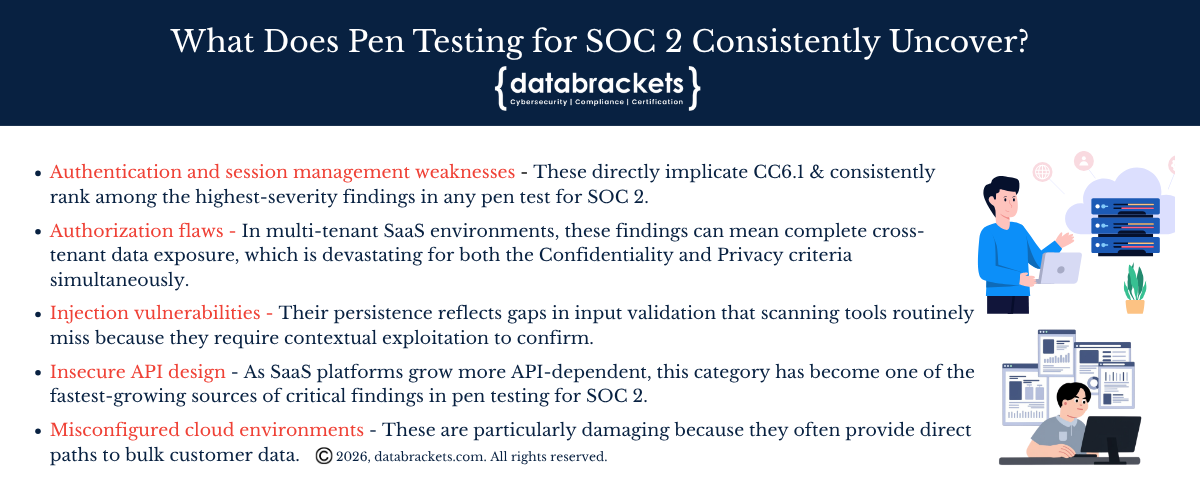
What Does Pen Testing for SOC 2 Consistently Uncover?
Pen testing for SOC 2 surfaces the same vulnerability classes repeatedly across SaaS environments. Familiarity with these patterns helps security teams prioritize pre-test remediation and allocate post-test budgets more effectively.
- Authentication and session management weaknesses. Broken authentication flows, missing or bypassable multi-factor authentication, insecure session tokens, and weak credential policies appear across almost every engagement. These directly implicate CC6.1 and consistently rank among the highest-severity findings in any pen test for SOC 2.
- Authorization flaws. Insecure direct object references, broken function-level access controls, and horizontal privilege escalation allow attackers to access data belonging to other users or organizations. In multi-tenant SaaS environments, these findings can mean complete cross-tenant data exposure, which is devastating for both the Confidentiality and Privacy criteria simultaneously.
- Injection vulnerabilities. SQL injection, command injection, and server-side template injection continue to appear in modern pen test reports despite being well-understood attack classes. Their persistence reflects gaps in input validation that scanning tools routinely miss because they require contextual exploitation to confirm.
- Insecure API design. Many organizations expose sensitive endpoints without adequate authentication, rate limiting, or input validation. As SaaS platforms grow more API-dependent, this category has become one of the fastest-growing sources of critical findings in pen testing for SOC 2.
- Misconfigured cloud environments. Overly permissive IAM roles, publicly accessible storage buckets, and exposed management interfaces regularly surface in cloud-native organizations. These findings are particularly damaging because they often provide direct paths to bulk customer data.
What Does A Good Pen Testing Report for SOC 2 Look Like?
Completing pen testing for SOC 2 is only half the work. The structure and content of the report determine whether auditors accept it as valid compliance evidence or question its sufficiency.
Every credible pen test report for SOC 2 includes an executive summary, a detailed methodology section, and full technical findings. Each finding requires a CVSS severity rating, proof-of-concept exploitation evidence, a specific remediation recommendation, and a mapping to its relevant TSC sub-criterion. Scope, tools used, and any testing limitations must appear explicitly in the methodology section; auditors need to understand not just what was found but how the test was conducted.
Retesting evidence, confirming that previously identified vulnerabilities no longer exist after remediation, belongs in the final deliverable. Auditors specifically look for this closed loop; an open vulnerability with no documented remediation is an unresolved compliance gap regardless of what your team says verbally.
Independence is a hard requirement throughout. A test conducted by your own engineering or security team, regardless of technical skill, lacks the independence auditors require. External, qualified providers are the only acceptable option for pen testing for SOC 2 intended as audit evidence.
What Are The Mistakes That Undermine Pen Testing for SOC 2
Organizations repeat the same errors with pen testing for SOC 2. Recognizing them in advance prevents qualified opinions, delayed reports, and difficult audit conversations.
- Scope misalignment. When pen test scope does not match the SOC 2 system description, auditors flag the discrepancy immediately. Every system in your system description should appear in your pen test scope; any gap is a compliance risk you are choosing to carry.
- Treating pen testing for SOC 2 as a one-time event. SOC 2 Type II requires ongoing evidence of control effectiveness over the entire observation period. A single test conducted immediately before the audit period ends does not demonstrate that standard convincingly.
- Substituting automated scans for genuine pen testing. Auditors distinguish clearly between scan reports and real pen test reports. Submitting one in place of the other damages credibility in ways that are difficult to recover from within the same audit cycle.
- Missing retest documentation. Identifying vulnerabilities without documenting that they were fixed and independently verified leaves auditors with open, unresolved gaps that generate management letter comments.
- Scheduling outside the audit observation period. This renders an otherwise excellent engagement nearly irrelevant as formal evidence; it is the most avoidable mistake in pen testing for SOC 2 and one of the most common.
How to Choose the Right Pen Testing Provider for SOC 2
Selecting the right partner directly determines the quality and auditor acceptance of pen testing for SOC 2. Not all providers produce reports that satisfy audit requirements, and the differences between them matter enormously.
Relevant certifications signal technical credibility. Look for OSCP (Offensive Security Certified Professional), CREST, and GPEN (GIAC Penetration Tester) among the testers assigned to your engagement. Request sample reports before signing any agreement; evaluate whether findings map to TSC sub-criteria, whether CVSS scoring appears throughout, whether exploitation evidence is included, and whether the methodology section is transparent and specific.
Ask about the provider’s direct experience with SOC 2 Type II engagements. Confirm that remediation support and retesting are included in the base scope, not billed as separate add-ons. A technically excellent pen test that produces a report unsuitable for audit evidence is time and money spent without compliance value.
What Is the Cost of Pen Testing for SOC 2?
Cost varies based on scope, environment complexity, and provider quality. For smaller SaaS environments with a single application and limited API surface, pen testing for SOC 2 typically ranges from $5,000 to $20,000. Organizations with multi-cloud infrastructure, multiple applications, and complex integrations should budget toward the upper range or beyond it.
Compliance-driven engagements cost more than general security assessments. They offer auditor-ready documentation, TSC sub-criterion mapping, and retesting. All these tasks add time and therefore cost; providers who include retesting within the base engagement scope are preferable to those who charge separately for it. It is advisable to understand that you will require Pen Testing on an annual basis.
A compliance-driven engagement with a SOC 2 readiness partner like databrackets not only helps you to ensure that you have auditor-ready documentation, but it is also cost effective to go with just one provider to offer more value. We issue technical severity reports which are audit-ready and when we conduct pen testing as part of SOC 2 readiness, it feeds directly into your gap analysis and control evidence.
PTaaS (Penetration Testing as a Service) platforms offer subscription-based models combining automated scanning with periodic manual testing. Annual subscriptions commonly start between $10,000 and $20,000. If you decide to work with a PtaaS platform, before selecting a provider for pen testing for SOC 2, confirm the platform includes genuine human-led manual testing components. Fully automated platforms do not satisfy auditor expectations, regardless of how the service is marketed.
Budget for quality rather than cost minimization. A pen test priced below $3,000 for a web application almost always means automated scanning repackaged as manual testing; that produces a list of known vulnerabilities, not the business logic flaws, authentication bypasses, and chained exploits that represent real attacker paths and genuine compliance evidence.
Summary
Pen testing for SOC 2 occupies a distinctive position in the compliance landscape. Written standards mark it optional; audit reality makes it indispensable. The AICPA Trust Services Criteria establish a risk-based, outcomes-focused model where organizations must prove controls work, not merely document them. Pen testing for SOC 2 delivers that proof in the most auditor-accepted form available.
The five Trust Services Criteria, Security, Availability, Processing Integrity, Confidentiality, and Privacy, create the lens through which auditors evaluate genuine data protection. Pen testing for SOC 2 addresses at minimum five specific sub-criteria: CC4.1 for monitoring activities, CC7.1 for vulnerability management, CC6.1 for logical access controls, A1.2 for availability protections, and C1.1 for confidentiality. Each finding mapped to a sub-criterion directly strengthens the audit evidence package.
Three testing methodologies serve different needs. Black box mirrors external attacker behavior; white box maximizes coverage depth; grey box balances realistic threat modeling with practical efficiency. Timing matters critically: Type I audits require one recent test close to the audit date, while Type II audits demand at minimum annual testing within the observation period. Scope must mirror the SOC 2 system description exactly. Reports need TSC mapping, CVSS ratings, exploitation evidence, and documented retesting. Independent third-party providers are non-negotiable throughout.
Costs for pen testing for SOC 2 range from $5,000 to $20,000 for most SaaS environments. The gap between organizations that execute pen testing for SOC 2 with discipline and those that treat it as a checkbox is the same gap separating clean, unqualified audit opinions from qualified reports, lost deals, and preventable breaches.
Key Takeaways
Align your pen test scope with your SOC 2 system description before engaging any provider. Every system your description covers must appear in the pen test scope. Any gap between the two is a compliance risk you are choosing to carry into the audit.
Schedule pen testing for SOC 2 within your audit observation period. For Type II, this means at minimum one test within your six to twelve month window. Build it into the compliance calendar at the start of each audit cycle, not as a last-minute preparation step.
Require TSC sub-criterion mapping in every pen test deliverable. Before signing an engagement, review sample reports from prospective providers. If findings are not mapped to specific TSC identifiers, those reports will not satisfy thorough audit scrutiny.
Run vulnerability scanning continuously alongside periodic pen testing for SOC 2. Scanning handles CC7.1 through ongoing detection; pen testing validates whether detected vulnerabilities are genuinely exploitable. Both together create a defensible, complete monitoring program.
Document remediation and retest every finding before your audit date. Auditors need a closed loop: vulnerability identified, fix implemented, fix independently verified. Missing retesting evidence is one of the most common reasons pen test results generate management letter comments rather than clean acceptance.
Use only independent, qualified third-party providers. Internal team testing does not meet the independence standard auditors require, regardless of technical skill level.
Retest after every significant infrastructure change. Annual pen testing for SOC 2 is a minimum floor, not a ceiling. New deployments, migrations, and integrations all change your attack surface between scheduled tests.
Budget for quality, not cost minimization. A pen test priced below $3,000 for a web application almost always delivers automated scanning repackaged as manual testing. That will not satisfy a thorough auditor, and more importantly, it will not protect your customers.
How databrackets can help you with Pen Testing for SOC 2
databrackets is an authorized & accredited FedRAMP 3PAO with ISO/IEC 17020:2012 accreditation from A2LA. We are also an authorized certifying body for ISO 27001 and an authorized C3PAO for CMMC. For over 15 years, we have been helping organizations achieve compliance or certification with the most rigorous cybersecurity and data privacy standards, including NIST SP 800-53, NIST SP 800-171, NIST Cybersecurity Framework, ISO 27001, SOC 2, CMMC, HIPAA, and GDPR. We offer specialized Pen Testing Services to organizations who want to comply with these and other global security frameworks. We are a trusted Pen Testing provider for CPAs who assess organizations for SOC 2. They prefer to avail our services due to our in-depth understanding of the SOC 2 framework and our focus on high-quality automated and human-led pen testing to thoroughly assess if security controls are operational. Our security experts have extensive knowledge of the SOC 2 framework, and they also know what CPAs actually want in your SOC 2 Audit. As your SOC 2 Compliance Readiness Partner, we bring a wealth of knowledge and experience about what makes you truly Audit-Ready and how you can get there. We focus on supporting your journey and we celebrate your success! Working with databrackets as your SOC 2 Compliance Readiness Partner can help you save a significant amount of time, money and resources. The tasks that we undertake, as your SOC 2 Compliance Readiness Partner include:- Initial Consultation and Scoping
- Educating the Client
- Gap Analysis
- Control Mapping
- Documentation Review and Development
- Remediation Planning
- Implementation Support
- Internal Audit
- Readiness Assessment Report
- Ongoing Support and Monitoring

Srini Kolathur
Co-Author: Aditi Salhotra
Manager – Digital Marketing and Business Development
Aditi is a Digital Marketing and Business Development Professional at databrackets.com. She is a strong advocate of good cyber hygiene and is proud of the company’s mission to safeguard organizations from cyber threats and ensure their business continuity in adverse situations.