
Selecting the wrong CMMC consultant costs defense contractors thousands of dollars and months of work, then forces them to start over. That is not conjecture. It is the documented pattern of organizations that treated their CUI boundary wrong from the start, built documentation around it for months, and arrived at their formal assessment with an evidence package their assessor could not accept.
The consulting market around CMMC is crowded with people who have taken training courses and are now selling services. Very few of them have spent real time inside the Defense Industrial Base (DIB) understanding how Controlled Unclassified Information (CUI) actually moves through a contractor’s environment, and fewer still know NIST SP 800-171 at the depth required to build documentation that survives a Certified Third-Party Assessment Organization’s (C3PAO) scrutiny.
This blog covers what a qualified CMMC consultant actually needs to know, what DIB experience looks like in practice, how penetration testing fits into your compliance picture, how CMMC compares to other security frameworks your organization may already hold, and the specific questions to ask before you hire anyone.
CMMC in DoD Contracts
CMMC requirements became enforceable in Department of Defense contracts on November 10, 2025, when the DoD published its final DFARS rule and began inserting CMMC clauses into new solicitations under DFARS 252.204-7021. Phase 1 of the rollout, currently underway, requires Level 1 and Level 2 self-assessments as a condition of contract award.
CMMC’ Phase 2 begins November 10, 2026, and fundamentally changes the equation: for most contracts involving CUI, third-party certification from an authorized C3PAO becomes the default requirement.
The preparation timeline is not forgiving. Most defense contractors handling CUI require between 6-24 months to get genuinely ready for a C3PAO assessment, depending on the size of their environment, their starting security posture, and the complexity of their CUI data flows. Organizations that discover midway through that their scope definition was wrong, that their System Security Plan (SSP) descriptions are too generic to support an assessor’s examination, or that their technical controls do not produce the evidence the assessment methodology requires, face the full cost of rework on top of the time already spent.
The DoD estimates that more than 76,000 organizations in the DIB need Level 2 C3PAO certification. As of early 2026, fewer than 1,100 had completed it, according to data published by the Cyber AB. That gap reflects both how recently enforcement began and how difficult, genuine readiness actually is. Choosing a consultant who helps you get there correctly on the first attempt is not a secondary decision. It is the central one.
The Two Critical Areas of Work Experience Required to Succeed at CMMC Compliance
Every capability a CMMC consultant claims, whether gap assessment, SSP development, evidence preparation, or mock assessment coordination, ultimately rests on two foundations. Without both, the deliverables may look professional but collapse under C3PAO scrutiny. With both, a consultant can navigate the specific, technical, and often unforgiving demands of a formal DoD certification process.
The first is deep, practical knowledge of NIST SP 800-171. The second is direct experience working inside the Defense Industrial Base. These are not interchangeable. A consultant who knows the standard deeply but has never worked in a defense contracting environment will misread scoping decisions and miss how CUI actually travels through a contractor’s operations. One who has spent years in defense contracting but lacks technical depth in the standard will produce documentation that looks compliant on the surface but fails assessment scrutiny in the details. Both are required, operating together, in every engagement.
The security controls at the heart of CMMC are not new. NIST SP 800-171 has governed the protection of CUI in defense contractor environments since 2017, when DFARS 252.204-7012 made compliance a contractual requirement across the defense supply chain. The underlying control families themselves draw directly from NIST SP 800-53, a federal security standard with roots going back to 2005. That means qualified independent consultants with a decade or more of hands-on experience implementing these controls inside real defense contractor environments do exist. The work is finding them, because they do not always carry the loudest marketing presence in a market crowded with newer entrants.
Why Knowledge of NIST SP 800-171 Matters
NIST Special Publication 800-171 is the technical foundation of CMMC Level 2. Published by the National Institute of Standards and Technology (NIST) and available at https://csrc.nist.gov/publications/detail/sp/800-171/rev-2/final, it defines 110 security requirements organized across 14 control families. Those families cover Access Control, Awareness and Training, Audit and Accountability, Configuration Management, Identification and Authentication, Incident Response, Maintenance, Media Protection, Personnel Security, Physical Protection, Risk Assessment, Security Assessment, Systems and Communications Protection, and System and Information Integrity. Every single requirement must be implemented and evidenced before a C3PAO marks a control as MET.
The phrase “110 controls” sounds manageable until you understand what is behind it. Each control has multiple assessment objectives, totaling 320 across the entire standard. A contractor must satisfy every one of those objectives, not just demonstrate that the general category is addressed.
Control 3.5.3, for example, requires multi-factor authentication (MFA) for local and network access to privileged accounts and for network access to non-privileged accounts. The assessment objective behind it requires not just that MFA exists, but that it is applied consistently across every access path, that exceptions are documented and justified, and that the implementation covers administrative interfaces, remote desktop sessions, and cloud management portals without gaps. A consultant who checks a box for MFA without understanding the full depth of that objective builds an SSP a C3PAO will challenge on assessment day.
Beyond individual controls, a consultant who understands NIST SP 800-171 deeply recognizes how the 14 families interact. Access Control depends on Identification and Authentication. Configuration Management intersects with System and Information Integrity. Incident Response depends on the audit infrastructure built under Audit and Accountability. A consultant who treats the families as an independent checklist builds evidence that fragments under scrutiny. One who understands the interdependencies builds an architecture that holds together across the full assessment.
The SSP demands this depth most visibly. The SSP is the primary document a C3PAO examines. It must describe your system boundary with precision, explain how each control is implemented in terms specific to your actual environment, document inherited controls and shared responsibility arrangements with cloud service providers, and reflect your current state accurately. Assessors read SSPs critically. Vague, template-level descriptions of controls get challenged immediately. Specific, technically accurate descriptions of real implementations withstand that scrutiny. The difference between those two outcomes is whether the consultant who wrote the SSP actually knew the standard or just knew the outline.
One more fact check is essential here. CMMC Level 2 assessments are conducted against NIST SP 800-171 Revision 2, not Revision 3, which was published by NIST in May 2024. The DoD issued a class deviation in May 2024 providing an alternative clause under DFARS 252.204-7012 to maintain Revision 2 as the governing version. C3PAO assessors are not authorized to evaluate against Revision 3. That deviation has no end date, meaning Revision 2 remains the standard until the DoD formally reschedules it. Any CMMC consultant who does not know this distinction, is operating from a factual gap that will affect every recommendation they make.
Why DIB Experience Matters
The DIB is not a generic sector with a cybersecurity overlay. It carries a specific regulatory architecture, a specific information-handling culture, and a set of operational realities that shape how security controls are built, maintained, and evidenced. A consultant who has only worked in commercial environments, however sophisticated, is learning about your environment on your timeline and your budget.
DIB experience begins with DFARS 252.204-7012, the cybersecurity clause that has governed defense contractor CUI handling since 2017 and flows down through every tier of the supply chain. This clause requires contractors to implement the 110 NIST SP 800-171 controls and to report cyber incidents affecting covered defense information to the DoD through the DIBNet portal at https://dibnet.dod.mil within 72 hours of discovery. It also requires preserving images of all affected systems and relevant monitoring and packet capture data for at least 90 days from the date of report submission. These are not abstract compliance concepts. They are operational requirements that interact directly with your CMMC posture, and a consultant without DIB experience may understand CMMC technically while remaining unfamiliar with the legal obligations surrounding it.
Beyond regulatory familiarity, DIB experience shapes how a consultant defines your CUI environment. CUI scoping, the process of identifying which systems, personnel, and data flows fall inside your CMMC assessment boundary, is where most organizations encounter their most expensive surprises. Your assessment boundary must encompass CUI Assets, Security Protection Assets, Specialized Assets, and Contractor Risk Managed Assets as defined in 32 CFR Part 170. Over-scoping your environment means implementing and evidencing controls for systems that CUI never touches, driving remediation costs well beyond what the actual risk requires. Under-scoping means arriving at your formal assessment with unprotected systems that should have been inside the boundary, producing findings that require remediation and re-assessment.
An experienced DIB consultant finds CUI flow paths that are invisible in an asset inventory. CUI does not stay neatly inside intended systems. It migrates into email threads, collaboration platforms, shared drives, and engineering workstations through the ordinary course of defense contract work. Identifying those paths requires direct conversation with your program managers and engineers about how they actually handle contract data, not a review of your IT diagram. A consultant who has never worked in a defense environment does not know which questions to ask those conversations to surface the migration paths assessors will examine.
DIB experience also means familiarity with the Supplier Performance Risk System, known as SPRS, where assessment scores and CMMC certification status are recorded and where contracting officers verify eligibility before contract award. Understanding how SPRS scores are submitted, what a self-assessment score reflects versus a C3PAO certification result, and how the unique assessment identifier required under DFARS 252.204-7021 is assigned and verified, are details that affect your contracts team’s ability to act. Consultants without that background may advise on the technical requirements while leaving the contractual mechanics poorly understood.
Furthermore, defense contractors navigating CMMC often handle ITAR-controlled technical data or EAR-governed information alongside CUI. These carry distinct marking, handling, and access control obligations that interact with how you define your assessment boundary. A consultant who understands this landscape identifies those intersections during scoping. One who does not may define a boundary that satisfies CMMC requirements on paper while creating compliance gaps in the adjacent regulatory obligations your contracts carry.
CMMC Consultant Deliverables
Clarity about the scope of work protects your investment and sets accurate expectations before an engagement begins. A qualified CMMC consultant working toward your Level 2 certification performs a defined sequence of activities, and understanding each one helps you evaluate whether a prospective consultant is proposing real work.
The engagement begins with scoping and gap assessment. Your consultant maps your CUI data flows, defines your assessment boundary, and examines your current security posture against all 110 NIST SP 800-171 requirements. The output is a prioritized findings report tied to specific control numbers and assessment objectives, not a generic compliance gap summary.
SSP development follows the gap assessment and reflects the remediation work your organization has completed. The SSP is the primary document your C3PAO will examine. It must describe your system environment and boundary with precision, explain how each required control is implemented in your specific environment, document cloud service provider relationships and inherited controls, and reflect your actual current state rather than an aspirational future state. Consultants who produce generic SSPs produce assessment findings.
The Plan of Action and Milestones, known as a POA&M, captures any controls not yet fully implemented, with specific responsible parties, remediation steps, and realistic completion dates. A well-maintained POA&M demonstrates active management of gaps. Under CMMC rules, POA&M items for Level 2 carry a 180-day remediation clock from the date of conditional CMMC status, after which unresolved items result in automatic termination of that status and contract ineligibility.
A mock assessment conducted before the formal C3PAO engagement simulates the Examine, Interview, and Test methodology your assessor will apply. Your consultant reviews your documentation, interviews your staff, and validates that your technical controls produce testable evidence. Organizations that skip this step discover their gaps during the real assessment, which is the most expensive possible time to find them. Preparation timelines that compress or eliminate the mock assessment stage are saving money in the wrong place.
The Three CMMC Levels and What Each Demands
CMMC operates at three levels, and placing your organization correctly before work begins is a fundamental consulting competency. Placing you at the wrong level means scoping the wrong controls and building the wrong evidence package.
Level 1, Foundational, applies to contractors handling Federal Contract Information. It requires meeting 17 practices drawn from FAR 52.204-21, verified through annual self-assessment and affirmation. The consulting burden here is minimal relative to the levels above.
Level 2, Advanced, applies to contractors handling Controlled Unclassified Information and is where the substantial majority of the defense industrial base operates. It requires full implementation of all 110 NIST SP 800-171 Revision 2 requirements. For most CUI contracts, it requires formal C3PAO certification, which becomes the default under Phase 2 beginning November 10, 2026. This level is where the entire depth of NIST SP 800-171 knowledge and DIB experience described in this blog applies directly.
Level 3, Expert, adds 24 enhanced requirements from NIST SP 800-172 on top of the complete Level 2 foundation. Roughly one percent of DoD contractors will require Level 3, assessed exclusively by the Defense Industrial Base Cybersecurity Assessment Center, known as DIBCAC. A contractor cannot begin a Level 3 assessment without first achieving a perfect score on a Level 2 C3PAO assessment, meaning all 110 NIST SP 800-171 controls must be fully MET with no open POA&M items before DIBCAC proceeds.
Penetration Testing for CMMC
Penetration testing is a structured, authorized attempt to exploit vulnerabilities in your systems by qualified professionals, to determine how far an adversary could actually advance through your environment and what they could access. It is different from a vulnerability scan, which identifies potential weaknesses without attempting to exploit them. C3PAO assessors know the difference and evaluate evidence quality accordingly.
At Level 2, penetration testing is not explicitly required by name in the CMMC requirements. Experienced C3PAO assessors consistently expect it, however, as substantive evidence of control effectiveness under the Security Assessment domain. Organizations presenting only automated scan output as security assessment evidence receive weaker findings than those presenting actual penetration test reports. A CMMC consultant who does not recommend penetration testing before your formal assessment as standard preparation is not advising you at the level the assessment environment requires.
At Level 3, penetration testing is explicitly required. NIST SP 800-172 practice 3.12.1e requires conducting penetration testing at least annually, or when significant changes are made to the system, using both automated scanning tools and ad hoc testing by qualified subject matter experts. DIBCAC assessors will not accept scan output as a substitute. The evidence chain must include scope documentation, a formal test report mapping findings to your assessment boundary, and verifiable evidence that your monitoring controls detected and logged testing activity as it occurred.
The scope of any penetration testing must align directly with your CMMC assessment boundary as defined in 32 CFR Part 170, covering CUI Assets, Security Protection Assets, and Specialized Assets. Testing that covers only your external perimeter while internal CUI-handling systems remain unvalidated does not produce evidence that holds up under assessment scrutiny.
In practice, CMMC-relevant penetration testing involves several distinct types. Network penetration testing examines internal and external infrastructure, attempting to exploit weaknesses in network segmentation, firewall configurations, access controls, and legacy systems. Application penetration testing targets the applications that process or access CUI, validating authentication mechanisms, testing authorization bypass scenarios, and examining data exposure paths. Social engineering testing, which simulates phishing campaigns against your staff, directly supports evidence for CMMC’s Awareness and Training domain. NIST SP 800-172 Level 3 specifically requires awareness training that covers social engineering and advanced persistent threat recognition. Cloud environment testing evaluates how your cloud configuration, whether Microsoft 365 GCC High, AWS GovCloud, or another authorized platform, enforces the boundary defined in your System Security Plan. Physical security testing assesses whether an adversary with physical access could reach systems that handle CUI, which matters more than most organizations acknowledge until an assessor begins examining physical protection controls.
A qualified consultant helps you define the right testing scope, identifies a provider whose methodology aligns with NIST SP 800-115, the federal government’s technical guide to information security testing available at https://csrc.nist.gov/publications/detail/sp/800-115/final, and ensures the resulting evidence is organized to serve your formal assessment.
How CMMC Compares to Other Security Standards
Many defense contractors already hold certifications under other frameworks. Understanding how those frameworks relate to CMMC determines how much of your existing investment carries forward and where new work is required. A consultant who oversells the credit your existing certifications provide creates false confidence that surfaces as assessment findings.
Standard | Governing Body | Who It Applies To | Control Count | Penetration Testing | Third-Party Assessment Required | Certification Produced |
CMMC | U.S. DoD / Cyber AB | DoD contractors handling FCI or CUI | L1: 17; L2: 110; L3: 134 | Not named at L1/L2 but advisable as proof for C3PAO; explicitly required annually at L3 under NIST SP 800-172 practice 3.12.1e | Required for most L2 and all L3; L1 is self-assessed | Certificate of CMMC Status |
ISO/IEC 27001:2022 | ISO / IEC | Any organization globally; voluntary | 93 Annex A controls | Not required; risk assessment may surface the need | Yes, by an ISO-accredited certification body | ISO 27001 Certificate |
SOC 2 | AICPA | U.S. service organizations; commercial trust relationships | No fixed count; Trust Services Criteria-based | Not required; relevant in availability or confidentiality contexts | Yes, by a licensed CPA firm | SOC 2 Type I or Type II Report |
NIST CSF 2.0 | NIST | Voluntary; widely used by critical infrastructure and private sector | 6 functions, 106 subcategory outcomes | Not required; surfaces as a risk management option | No formal assessment required | No certificate issued |
FedRAMP | U.S. GSA / OMB | Cloud service providers selling to federal agencies | NIST SP 800-53 Rev 5 based; High baseline: 421 controls | Required as part of the 3PAO assessment | Yes, by a FedRAMP-authorized Third-Party Assessment Organization | Authority to Operate (ATO) |
What Each Comparison Means in Practice
CMMC 2.0 is the only framework in this table that directly governs eligibility for DoD contract award. Organizations that cannot demonstrate the required CMMC level are ineligible for award under DFARS 252.204-7021. No other certification on this list substitutes for it in a DoD solicitation. The three-level structure means the consulting and compliance investment scales materially from Level 1 through Level 3.
ISO 27001 is a globally recognized management system standard requiring 93 Annex A controls and an external certification audit by an accredited body. The official standard is published at https://www.iso.org. Organizations holding ISO 27001 certification have meaningful overlap with CMMC Level 2, particularly in access management, incident response, risk assessment, and asset management. The overlap is real and reduces duplicate work. However, ISO 27001 does not address CUI-specific scoping obligations, SPRS mechanics, DFARS incident reporting requirements, or the contractual structure under DFARS 252.204-7012. A consultant who accurately maps ISO 27001 controls to NIST SP 800-171 requirements and then identifies the remaining gaps is delivering honest value. One who tells you that ISO 27001 covers most of what you need without specifying what remains is leaving you unprepared.
SOC 2 is an attestation framework governed by the American Institute of Certified Public Accountants, whose standards are available at https://www.aicpa-cima.com. It allows service organizations to demonstrate security and operational trustworthiness through assessment against the Trust Services Criteria covering security, availability, processing integrity, confidentiality, and privacy. SOC 2 is entirely market-driven, designed for commercial trust relationships rather than regulatory compliance. A SOC 2 Type II report covering the security criterion evidences mature control design and operating effectiveness over a defined period. That evidence has thematic overlap with some CMMC Level 2 control areas. It carries no weight in a DoD solicitation and will not be referenced by a C3PAO assessor as credit toward any CMMC requirement.
NIST CSF 2.0 is a voluntary risk management framework issued by the National Institute of Standards and Technology, available at https://www.nist.gov/cyberframework. It organizes cybersecurity activities across six functions: Govern, Identify, Protect, Detect, Respond, and Recover. The CSF produces no certificate, requires no external validation, and does not map directly to the 110 requirements of NIST SP 800-171. Its value for defense contractors is primarily internal, providing a language for security posture conversations with leadership and a structure for managing the continuous improvement model that CMMC’s ongoing compliance obligations require. Presenting CSF tier alignment as progress toward CMMC certification conflates two distinct purposes.
FedRAMP, administered by the U.S. General Services Administration and described at https://www.fedramp.gov, is the authorization framework governing cloud service providers that sell to federal agencies. It is based on NIST SP 800-53 Revision 5, with the High baseline encompassing 421 controls, making it the most demanding framework in this comparison by control count. FedRAMP and CMMC serve different populations and do not substitute for each other. Cloud service providers with FedRAMP authorization at an appropriate impact level may qualify as authorized external cloud service providers within a CMMC assessment boundary, which can simplify the scoping picture for defense contractors using those platforms. Standard commercial Microsoft 365 does not meet the cloud service requirements for CUI handling under DFARS 252.204-7012. Microsoft 365 GCC High does, and that distinction has direct compliance and cost implications your consultant must understand before scoping begins.
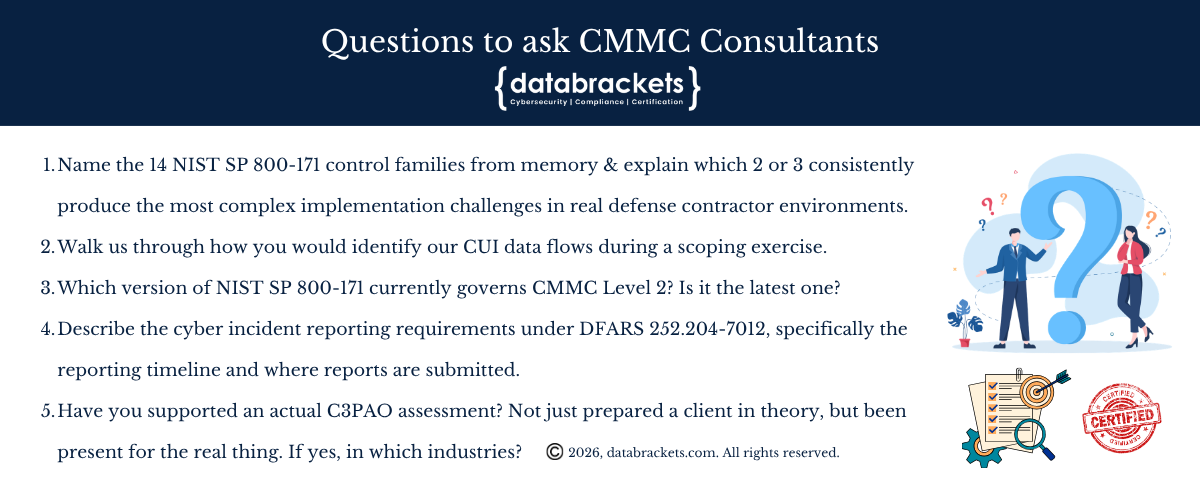
Questions to ask CMMC Consultants
The goal of every selection conversation is to distinguish between someone who knows this subject at the depth required and someone who has studied it from a distance. These questions produce diagnostic answers. A qualified consultant responds with specific, technically precise detail without hesitation. One who is not qualified gives general answers that sound plausible but contain no specifics.
Ask the consultant to name the 14 NIST SP 800-171 control families from memory and explain which two or three consistently produce the most complex implementation challenges in real defense contractor environments. A consultant with genuine depth names specific families, describes the implementation nuances that create difficulty, and connects those nuances to concrete scenarios they have encountered. One without that depth speaks in generalities about access control or incident response without demonstrating technical specificity.
Ask them to walk you through how they would identify your CUI data flows during a scoping exercise. A consultant with real DIB and scoping experience describes a specific discovery process involving interviews with program managers, examination of contract data requirements lists, review of cloud storage configurations, and interrogation of email and collaboration platforms for CUI migration paths. One without that experience describes a process that begins with your network diagram.
Ask what version of NIST SP 800-171 currently governs CMMC Level 2 assessments and why Revision 3 does not apply. The correct answer is Revision 2, maintained through a DoD class deviation issued in May 2024 with no end date. Any hesitation or vague answer is diagnostic.
Ask them to describe the cyber incident reporting requirements under DFARS 252.204-7012, specifically the reporting timeline and where reports are submitted. The answer is 72 hours from discovery, through the DIBNet portal at https://dibnet.dod.mil, with system image preservation required for at least 90 days following report submission. A consultant who has worked in the DIB answers immediately and completely. One who has not either does not know or gives a partial answer.
Ask for a specific count of Level 2 organizations they have carried through successful C3PAO assessments and what those organizations’ industries were. Real track records produce specific numbers and industries. Thin track records produce references to current engagements, to readiness work still underway, or to DFARS 252.204-7012 compliance experience without completed certifications.
It’s also worth asking whether the consultant has supported an actual C3PAO assessment. Not just prepared a client in theory, but been present for the real thing. Thousands of assessments have now been completed across DIBCAC and authorized C3PAOs. That means firsthand experience with real audits is increasingly available, and worth seeking out. A consultant who has sat through an assessment knows how evidence gets challenged. They know where documentation gaps tend to surface. They know what assessors actually probe for. That kind of grounding shows up directly in how well they prepare a client for certification.
Red Flags in CMMC Consulting
Some responses during the selection process are not caution signs to weigh. They are disqualifying signals that should end the conversation before a proposal stage.
Any consultant who cannot answer the questions above with specific, concrete responses should not proceed further. Vague answers reflect vague work, and vague work does not survive C3PAO scrutiny on the first attempt.
Firms that guarantee a passing assessment outcome before scoping your environment are selling something that does not exist. The outcome depends on your controls, your documentation, and an independent assessor’s judgment. No honest consultant guarantees results before understanding your current state.
Consultants who present vulnerability scanning as equivalent to penetration testing demonstrate a technical gap that will directly affect your assessment evidence quality. The two are not interchangeable, and any professional who conflates them should not be trusted with your evidence architecture.
Firms proposing identical timelines regardless of your organization’s size, CUI footprint, or starting security posture are working from a sales process rather than a scoping process. Your timeline should emerge from a scoping conversation about your specific environment, not precede it as a fixed deliverable.
Any consultant who does not raise the false scope risk proactively, specifically the difference between over-scoping your entire IT environment and correctly defining a defensible CUI boundary, is missing the most important cost-management decision in your entire compliance program.
CMMC Consulting Costs
These figures reflect current market conditions and will vary materially based on your environment’s complexity, starting security posture, and the experience level of the consultant you engage.
Professional gap assessments by qualified CMMC consultants currently run from approximately $35,000 to $150,000 depending on organization size and CUI environment complexity. Fully managed Level 2 preparation engagements covering gap assessment, SSP development, remediation support, evidence organization, and mock assessment have been observed starting at $25,000 – $35,000 for organizations with a 25-to-100-seat CUI footprint, per current market data. Hourly rates for experienced CMMC consultants currently range from approximately $250 to $400 per hour, with Level 2 implementations typically requiring several hundred total hours of support.
The C3PAO assessment itself, a separate engagement from your consulting firm, has been observed in the range of approximately $40,000 to $100,000 depending on organization size and scope. Total Level 2 certification investment, including consulting, assessment, and technology remediation, has ranged significantly, with small businesses averaging closer to $138,000 in total investment based on market observations from the current certification cycle. These are market observations reflecting current conditions, not fixed figures.
The most effective cost management tool available is accurate CUI scoping upfront. An organization that correctly narrows its assessment boundary to only those systems through which CUI actually flows avoids remediating systems that did not need to be in scope and pays for an assessment against the actual environment rather than an inflated one. A consultant who helps you achieve that boundary definition before remediation begins delivers financial value that compounds across every subsequent cost in the engagement.
Summary
Selecting a CMMC consultant is a decision with direct contract eligibility consequences and significant financial stakes. The two factors that actually predict whether an engagement succeeds are deep, working knowledge of NIST SP 800-171 in its full technical depth, covering all 110 requirements across 14 control families and 320 assessment objectives, and genuine experience working inside the Defense Industrial Base. Neither substitutes for the other.
CMMC Level 2 assessments are conducted against NIST SP 800-171 Revision 2, maintained through a DoD class deviation with no current end date. The consultants who get organizations through their C3PAO assessments on the first attempt understand every assessment objective behind every control, know how CUI actually travels through defense contractor operations, and produce evidence documentation that supports all three assessment methods: Examine, Interview, and Test. The consultants who produce expensive rework are those who know the category labels without knowing the technical depth underneath them, and who have learned the regulatory vocabulary without ever having applied it inside a real defense environment.
Penetration testing, while not named explicitly at Level 2, is expected as substantive control-effectiveness evidence and is explicitly required annually at Level 3 under NIST SP 800-172. Scoping that testing correctly to your CMMC assessment boundary is a consulting competency, not an administrative detail. The comparison between CMMC and other frameworks such as ISO 27001, SOC 2, NIST CSF, and FedRAMP confirms that each framework serves a distinct purpose and that none substitutes for CMMC in a DoD contract context, though real overlaps exist and should be honestly mapped. Phase 2 mandatory C3PAO assessment begins November 10, 2026. The preparation timeline is 6-24 months. Both facts matter when deciding how much time you can afford to spend interviewing the wrong consultants.
Key Takeaways
Test NIST SP 800-171 depth before anything else. Ask every prospective consultant to name all 14 control families from memory and describe the implementation challenges that consistently arise in two or three of them in real defense contractor environments. Specific, technically precise answers confirm genuine knowledge. Vague answers about access control and incident response confirm someone who knows the outline, not the standard.
Verify DIB experience through operational questions, not a resume. Ask candidates to walk through how they would identify your CUI data flows during a scoping exercise. Ask what DFARS 252.204-7012 requires within 72 hours of a cyber incident, where reports are submitted, and what preservation obligation follows. Answers that are specific and immediate confirm actual defense experience. Any follow-up email required to answer them confirms the opposite.
Confirm the governing NIST SP 800-171 version on the spot. CMMC Level 2 assessments run against Revision 2, not Revision 3. The DoD class deviation issued in May 2024 has no end date. Any consultant who does not know this immediately is working from incomplete foundational knowledge.
Commission penetration testing before your formal C3PAO assessment. At Level 2, assessors distinguish substantively between organizations that have validated controls through actual exploitation testing and those that have run automated scans. At Level 3, annual penetration testing covering your full assessment boundary is a hard requirement under NIST SP 800-172. Ensure your consultant can define the right scope and identify a provider whose methodology aligns with NIST SP 800-115.
Get the CUI scoping right before remediation begins. Scoping errors are among the most expensive mistakes in CMMC preparation. Over-scoping forces you to remediate systems CUI never touches. Under-scoping produces assessment findings requiring rework. The right consultant defines your defensible boundary before a single control is implemented, not after.
Demand a documented track record, not a capabilities statement. Ask specifically how many Level 2 organizations the consultant has carried through successful C3PAO assessments, what industries they were in, and what the first attempt pass rate was. Firms with real track records answer these questions directly and specifically. Those without them describe current pipelines, pending engagements, or adjacent experience that is not the same thing.
databrackets as your CMMC Consultant
databrackets is an authorized C3PAO and independent consulting organization for CMMC. We offer Certification OR Readiness and Consulting services for CMMC. To avoid a conflict of interest and abide by CMMC’s independence requirements, we do not offer both services to the same client. We offer Pen Testing services for CMMC as part of our Consulting services and not as a C3PAO.
We are an ideal partner for either service since we bring over 15 years of proven expertise in helping organizations achieve compliance or certification with the most rigorous cybersecurity and data privacy standards, including NIST SP 800-53, NIST SP 800-171, NIST Cybersecurity Framework, ISO 27001, SOC 2, CMMC, HIPAA, and GDPR. We are an authorized certifying body for ISO 27001 and 3PAO for FedRAMP.
We specialize in transforming CMMC compliance from a daunting obstacle into a strategic business enabler.
- Proven Track Record: Over 15 years supporting organizations across diverse industries with complex compliance requirements
- Comprehensive Approach: End-to-end support from initial assessment through ongoing compliance
- Industry Recognition: Authorized certifying body for ISO 27001 and 3PAO for FedRAMP
- Strategic Partnership: We don’t just help you achieve compliance—we help you leverage it for competitive advantage.
Our Comprehensive CMMC Compliance Services include:
- Strategic Planning & Assessment:
- CMMC readiness assessments and comprehensive gap analysis
- CUI system boundary definition and scoping guidance
- Network architecture documentation and CUI flow diagrams
- Risk assessment and vendor compliance evaluations
2. Implementation & Documentation Support:
- System Security Plan (SSP) development and customization
- Complete policy and procedure documentation suite
- FIPS validation documentation and shared control matrices
- Evidence collection strategies and management systems
3. Assessment Preparation:
- Mock assessments and readiness validation
- CMMC documentation optimization and organization
- Personnel training and assessment preparation
- C3PAO coordination and selection support
4. Ongoing Compliance:
- Continuous monitoring and compliance maintenance
- Annual affirmation support and triennial assessment preparation
- Change management and configuration control guidance
- Customized CUI awareness training programs
For immediate assistance with your CMMC compliance journey, contact our certified experts at sales@databrackets.com or schedule a free consultation.

Srini Kolathur
Co-Author: Aditi Salhotra
Manager – Digital Marketing and Business Development
Aditi is a Digital Marketing and Business Development Professional at databrackets.com. She is a strong advocate of good cyber hygiene and is proud of the company’s mission to safeguard organizations from cyber threats and ensure their business continuity in adverse situations.