
Every organization choosing a pen testing vendor has real money on the line, and the wrong choice will cost you the contract, the certification, or both. Five major security standards either require or implicitly require penetration testing, and none of them will accept a report that fails their evidence standards.
This blog covers what pen testing is, why human-led testing is not interchangeable with automated scanning, how CMMC, SOC 2, FedRAMP, HIPAA, and ISO 27001 each treat penetration testing, and precisely what to look for when selecting a pen testing vendor. Every organization that needs to prove its security controls work, whether to a government assessor, a certification body, or an enterprise customer, will find the criteria here directly applicable.
The market for penetration testing services is crowded, and the quality gap is wide. Organizations that select a pen testing vendor on price alone regularly end up with reports their auditors or assessors cannot use as compliance evidence.
What Pen Testing Is & Why It’s Not the Same as Vulnerability Scanning
Before selecting a pen testing vendor, every organization needs clarity on what penetration testing actually does, because the confusion between pen testing and vulnerability scanning causes real compliance failures.
Vulnerability scanning is automated. A scanner checks your environment against a database of known weaknesses, flags what it recognizes, and produces a ranked list. The work is necessary, required under most frameworks, and appropriate for frequent runs. However, a scanner cannot tell you whether an attacker could actually get in, escalate privileges, move laterally, and reach your most sensitive data. It only reports what it was programmed to look for.
Penetration testing is adversarial and human led. A qualified tester simulates an actual attacker, chaining discovered weaknesses, misconfigurations, logic flaws, and trust relationships into access paths that prove real impact. A scanner might flag three separate low-severity findings. A penetration tester chains those same three findings together and demonstrates root access to your most sensitive systems. That is the difference auditors and assessors’ score.
Human-Led versus Automated Pen Testing
This distinction matters significantly for vendor selection. Automated pen testing tools have advanced and can scan large environments quickly, identify known vulnerability patterns, and generate reports at scale. They have a legitimate role in continuous monitoring and pre-test reconnaissance. However, for compliance-driven engagements, they are not a substitute for human-led testing. Here is why this matters practically:
- Automated tools test against known signatures. Human testers find novel attack paths and business logic flaws that no automated tool has been programmed to detect.
- Chained exploits, where multiple severity findings combine into a critical access path, require human judgment to identify and demonstrate. Automated tools report individual findings in isolation.
- Compliance frameworks evaluate the quality of evidence. FedRAMP’s Penetration Test Guidance explicitly states the test “should not be strictly limited to automated scanning techniques but manual techniques as well” (https://www.fedramp.gov/resources/documents/CSP_Penetration_Test_Guidance.pdf). SOC 2 auditors expect human-driven, adversarial testing that can uncover business logic issues and chained exploits. A report generated entirely by automated tools will not satisfy these reviewers.
- Proof of exploitation is required. Compliance reports must document that vulnerabilities were actually exploited, not merely detected. Human testers produce exploited findings with proof-of-impact evidence. Automated tools produce potential findings, many of which are false positives.
When evaluating a pen testing vendor, ask directly whether testing is human led. Vendors who lead with automation platforms and AI-generated reports as their primary compliance deliverable are describing a tool, not a service. Automation as part of a hybrid engagement, where automated tools handle reconnaissance and broad scanning while human testers focus on chained exploitation and business logic, is appropriate and efficient. Automation as the sole deliverable is not.
Types of Pen Testing
Understanding what types of testing exist is essential before selecting a pen testing vendor, because your compliance requirement and environment determine which types you need. Common types include:
- Network penetration testing. Targets internal and external network infrastructure. This is the foundation of most compliance-driven engagements and is relevant to every standard discussed in this blog.
- Web application penetration testing. Focuses on custom web applications and APIs, looking for injection flaws, authentication bypass, broken access controls, and business logic vulnerabilities. Required when your organization uses custom-developed software to process, store, or transmit regulated data.
- Internal penetration testing. Simulates an attacker who already has some access inside your perimeter. Tests whether lateral movement is possible, whether privilege escalation paths exist, and whether sensitive data is reachable from an assumed-breach starting point.
- Cloud penetration testing. Tests cloud configurations, identity and access management policies, storage permissions, and cloud-to-cloud trust relationships. Increasingly relevant as regulated workloads move to cloud environments.
- Red team exercises. Simulate a full adversary campaign from initial access through lateral movement, privilege escalation, and data exfiltration, typically using techniques documented in the MITRE ATT&CK framework (https://attack.mitre.org). Required for CMMC Level 3 and FedRAMP High systems under NIST SP 800-53 control CA-8(2).
- Social engineering testing. Tests whether employees can be manipulated into providing credentials or access. FedRAMP’s Penetration Test Guidance identifies external-to-corporate attacks, including phishing, as a mandatory attack vector for cloud service providers.
- Purple team engagements. Layer red team attack simulation with active collaboration between testers and your defensive team, measuring detection and response capability in real time.
Your specific standard and environment determine which of these apply. A pen testing vendor should be able to explain which types are relevant to your program and why, before the engagement begins.
What 5 Security Standards Require
Given below is a summary of five standards that drive most compliance-based penetration testing programs. What follows is a crisp summary of each, with links to detailed coverage for organizations that need to go deeper. You need to ensure you understand your specific requirements before selecting your pen testing vendor.
CMMC (Cybersecurity Maturity Model Certification)
CMMC applies to organizations in the U.S. defense industrial base. Level 2 Certification requires an assessment by an accredited Certified Third-Party Assessment Organization, or C3PAO. Pen testing is not named explicitly but it is the most direct way to produce Test-method evidence under NIST SP 800-171 Requirements 3.11.2, 3.12.1, and 3.12.3. C3PAOs evaluate evidence across three methods: Examine, Interview, and Test. A penetration test produces Test-method evidence for multiple controls simultaneously. No other single activity does that. Arriving at a CMMC assessment without pen test evidence leaves your strongest evidence category exposed. Learn more about Pen Testing for CMMC.
SOC 2
SOC 2 is the AICPA’s framework for service organizations. The Trust Services Criteria never use the phrase “penetration test.” Technically, it is not a named requirement. Practically, auditors overwhelmingly expect it. Common Criteria CC4.1 requires ongoing evaluations confirming controls are present and functioning, and the AICPA’s guidance references penetration testing as an example evaluation method. Criteria CC7.1 and CC7.2 address vulnerability identification and security event evaluation. Organizations that arrive at a SOC 2 Type II audit without a recent pen test routinely receive qualified opinions or management letter comments. Learn more about Pen Testing for SOC 2
FedRAMP
FedRAMP applies to cloud service providers seeking federal government contracts. Unlike the other frameworks, FedRAMP makes penetration testing explicitly mandatory by regulation for Moderate and High impact systems. All testing must be performed by an accredited Third-Party Assessment Organization, or 3PAO. No exceptions. Internal staff cannot conduct the test. The initial authorization requires a pen test, and continuous monitoring requires annual retesting. All mandatory attack vectors defined in the FedRAMP Penetration Test Guidance (https://www.fedramp.gov/resources/documents/CSP_Penetration_Test_Guidance.pdf) must be covered. For FedRAMP High systems, red team exercises are also required under NIST SP 800-53 control CA-8(2). Learn more about FedRAMP Pen Testing.
HIPAA
HIPAA governs covered entities and business associates handling electronic Protected Health Information, or ePHI. The current Security Rule does not name penetration testing explicitly. The Evaluation Standard at §164.308(a)(8) requires regular technical and non-technical evaluations of security safeguards, and penetration testing is the strongest way to satisfy that obligation. Separately, HHS OCR issued a Notice of Proposed Rulemaking on January 6, 2025, published in the Federal Register at 90 FR 898, proposing to add an explicit annual penetration testing requirement along with biannual vulnerability scanning. OCR had targeted May 2026 for finalization, though confirmation had not been issued at the time this blog was written. Until a final rule is published, the current rule remains in force. The HHS fact sheet on the proposed changes is at https://www.hhs.gov/hipaa/for-professionals/security/hipaa-security-rule-nprm/factsheet/index.html. Learn more about Pen Testing for HIPAA.
ISO 27001:2022
ISO 27001 is the international information security management standard. Like SOC 2, it does not name penetration testing as an explicit requirement. Two Annex A controls make it unavoidable at a serious Stage 2 certification audit. Annex A 8.8, Management of Technical Vulnerabilities, requires identifying technical vulnerabilities and taking action. ISO 27002:2022 implementation guidance for this control specifically recommends periodic, documented penetration tests. Annex A 8.29 requires security testing in development and acceptance. Clause 9.1 requires ongoing measurement of whether controls are functioning. Certification auditors treat a credible pen test as the expected verification evidence for these controls. Learn more about Pen Testing for ISO 27001 Certification.
Pen Testing Requirements Across Five Security Standards
The table below compares how each standard treats penetration testing.
Dimension | CMMC Level 2 (C3PAO) | SOC 2 | FedRAMP (Moderate/High) | HIPAA | ISO 27001:2022 |
Pen testing explicitly required? | No, but strongly implied by assessors | No, but auditors overwhelmingly expect it | Yes, mandatory | No (proposed rule pending finalization) | No, but certification auditors expect it |
Minimum frequency | Risk-based; C3PAO expects recent evidence | Annual; after major changes | Annual during continuous monitoring | Risk-based; proposed rule: annual | Annual; after significant changes |
Who can perform it | Independent qualified firm (not the C3PAO or RPO) | Independent third party preferred | Accredited 3PAO only | Independent qualified firm | Internal or external; external preferred by auditors |
Human-led testing required? | Yes; Test-method evidence requires human exploitation | Yes; auditors reject automated-only reports | Yes; FedRAMP guidance explicitly requires manual techniques | Yes; OCR expects evidence of real attack simulation | Yes; auditors expect adversarial human testing |
Types of testing relevant | Network, internal, web application (for custom CUI apps) | Network, web application, API, cloud | All mandatory FedRAMP attack vectors; red team for High/Moderate under CA-8(2) | All systems touching ePHI: network, web apps, APIs, cloud, backups | External, internal, web apps within ISMS boundary |
What happens without it | Weak Test-method evidence; C3PAO identifies the gap | Qualified opinion risk; management letter comments | Authorization delayed or denied | OCR audit exposure; potential civil penalties | Nonconformity finding; certification at risk |
Report must map to framework? | Yes, to NIST SP 800-171 control requirements | Yes, to AICPA Trust Services Criteria | Yes, per FedRAMP Penetration Test Guidance | Yes, mapped to ePHI systems and risk analysis | Yes, to Annex A controls |
What each row means in practice:
The row on whether penetration testing is explicitly required confirms that FedRAMP stands apart from all four other standards. For Moderate and High cloud systems, testing is a regulatory requirement with no exception pathway for internal testing. For CMMC Level 2, SOC 2, HIPAA, and ISO 27001, the written frameworks do not name it, but the audit and assessment reality demands it in every case. Organizations that use “technically not required” as justification for skipping testing routinely discover this distinction during their assessment or audit, at the worst possible moment.
The minimum frequency row confirms that annual testing is the practical baseline across all five standards. Risk-based language in CMMC, HIPAA, and ISO 27001 means the frequency scales upward when your environment changes significantly. A major architecture change, a new cloud deployment, or a significant application release resets the testing clock regardless of when the last test occurred.
The who can perform it row has one hard edge. FedRAMP mandates accredited 3PAOs with zero flexibility for internal teams regardless of their qualifications. For CMMC, independence is equally specific: the C3PAO conducting your certification and the firm conducting your pen test must be separate organizations, and an RPO cannot deliver penetration testing as part of readiness preparation. For all other standards, independent third-party testing is either the requirement or the practical expectation, because self-testing fails the independence standard that reviewers apply.
The human-led testing row is the one most directly relevant to vendor selection. Across all five standards, compliance reviewers expect human-driven, adversarial testing. FedRAMP makes this explicit in its guidance. SOC 2 auditors have increasingly rejected reports produced primarily by automated platforms because those reports cannot demonstrate chained exploitation or business logic vulnerabilities. Selecting a pen testing vendor who delivers automation-first output for compliance engagements is selecting a vendor whose report may not satisfy your reviewer.
The types of testing row shows that scope requirements differ meaningfully by standard and by environment. FedRAMP’s mandatory attack vectors are defined specifically in the GSA’s Penetration Test Guidance and include cloud-specific surfaces not covered by standard commercial pen testing. HIPAA scope must cover all systems touching ePHI, including EHRs, patient portals, mobile applications, APIs, and business associate connections. CMMC scope must align with your assessment boundary covering CUI Assets, Security Protection Assets, and Specialized Assets. Testing only your external perimeter when the standard requires internal system coverage is a scoping failure that auditors and assessors identify.
The consequences row is the one with money attached. A FedRAMP authorization denial represents real revenue foregone from federal contracts requiring an active Authority to Operate. A CMMC assessment failure delays certification, and certification delays cost defense contracts. A qualified SOC 2 opinion is visible to every enterprise customer reviewing your report. OCR civil monetary penalties for HIPAA violations range from $145 per violation to $2,190,294 per violation at the willful-neglect tier, per the January 2026 inflation adjustment published by HHS. ISO nonconformity findings delay certification and require formal corrective action with a follow-up audit.
The report mapping row is both the most overlooked and the most practically impactful criterion in vendor selection. A report mapped to NIST SP 800-171 control requirements is compliance evidence for a CMMC C3PAO. A generic severity-ranked vulnerability list is not. This distinction determines whether the engagement is a compliance investment or a sunk cost.
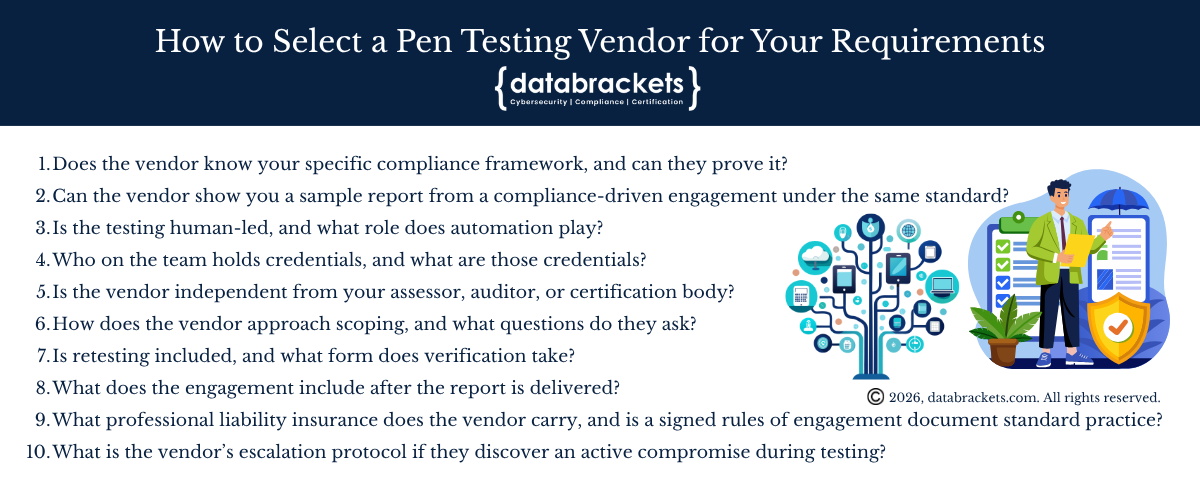
How to Select a Pen Testing Vendor for Your Requirements
Most organizations do not know they selected the wrong pen testing vendor until their auditor or assessor asks for something the report does not contain. The questions below prevent that discovery from happening on assessment day. Work through each one before signing an engagement letter.
- Does the vendor know your specific compliance framework, and can they prove it?
- Ask them to name the specific controls, criteria, or requirements their findings will map to in your deliverable.
- For CMMC, that means NIST SP 800-171 requirements 3.11.2, 3.12.1, and 3.12.3. For SOC 2, that means AICPA Trust Services Criteria, particularly CC4.1, CC6.1, CC6.6, CC7.1, and CC7.2. For FedRAMP, that means the mandatory attack vectors in the GSA Penetration Test Guidance. For HIPAA, that means ePHI system scope mapped to the Evaluation Standard at §164.308(a)(8). For ISO 27001, that means Annex A 8.8 and 8.29.
- A vendor who gives a vague answer about “following industry best practices” without naming your framework’s specific controls is describing a vendor who produces generic reports, not compliance evidence.
- Can the vendor show you a sample report from a compliance-driven engagement under the same standard?
- Request a redacted sample. Review it for scope documentation, methodology narrative, control mapping, proof of exploitation for each finding, remediation recommendations, and a retest section.
- A sample report eliminates more unqualified vendors faster than any other single evaluation step.
- If the vendor has no sample from a CMMC, FedRAMP, SOC 2, HIPAA, or ISO 27001 engagement, they are learning on your budget and your timeline.
- Is the testing human-led, and what role does automation play?
- Ask the vendor to describe their methodology. Specifically ask whether findings are validated by human testers before appearing in the report.
- Confirm that chained exploitation, business logic testing, and assumed-breach scenarios are part of the engagement for internal testing components.
- A legitimate answer describes automation as a tool in a human-led process. A concerning answer describes an automated platform that generates compliance reports.
- Who on the team holds credentials, and what are those credentials?
- For any compliance-driven engagement, request the names and credentials of the specific individuals who will conduct the test.
- Offensive Security Certified Professional, or OSCP, issued by OffSec, is widely regarded as the strongest hands-on credential because its 24-hour practical exam requires compromising live machines, not answering multiple-choice questions.
- GIAC Penetration Tester, or GPEN, issued through the SANS Institute’s GIAC program, is well-recognized in enterprise and government contexts and maps to DoD 8570/8140 requirements.
- For FedRAMP engagements specifically, the penetration testing team lead must hold an industry-recognized credential as defined by the A2LA R311 requirements program. Confirm the specific credential before engaging.
- Ask how many years of relevant engagement experience the assigned testers carry. Credentials without experience are a weaker signal than credentials with a demonstrable engagement history.
- Is the vendor independent from your assessor, auditor, or certification body?
- For CMMC, your pen testing vendor and your C3PAO must be separate organizations. An RPO cannot conduct penetration testing as part of readiness work.
- For FedRAMP, only accredited 3PAOs may perform testing. Verify accreditation status directly through the FedRAMP Marketplace before engaging.
- For SOC 2 and ISO 27001, the vendor should have no financial relationship with your auditor or certification body.
- Ask the vendor directly whether they have any existing relationship with the organization that will evaluate your compliance. Any hesitation on this question is a red flag.
- How does the vendor approach scoping, and what questions do they ask?
- A qualified vendor does not accept whatever scope you define without asking follow-up questions.
- Questions a competent vendor should raise include: What systems handle your regulated data? Where do internal users authenticate? Which applications are custom developed versus commercial off-the-shelf? What cloud environments are in scope? Are there operational technology or IoT devices in the assessment boundary?
- A vendor who accepts your initial scope without clarifying questions will produce a test that covers only what you remembered to include.
- Is retesting included, and what form does verification take?
- Confirmation that findings were remediated requires a formal artifact, not verbal assurance.
- Ask whether retesting is included in the engagement price or billed separately.
- Confirm that verification produces a standalone document, whether a supplemental report, a written retesting attestation, or a dated retest section within the original report showing each original finding and its confirmed resolution status.
- Without a retesting artifact, you hold the findings but cannot demonstrate to your reviewer that you addressed them.
- What does the engagement include after the report is delivered?
- A competent pen testing vendor provides remediation guidance specific to each finding, not generic “patch this” recommendations.
- Ask whether the vendor is available for technical questions during your remediation period.
- Confirm whether a debrief session with your technical team is included.
- What professional liability insurance does the vendor carry, and is a signed rules of engagement document standard practice?
- Penetration testing involves authorized attempts to exploit your systems. Professional liability insurance and errors-and-omissions coverage are non-negotiable for any qualified vendor.
- Rules of engagement documentation defines authorized scope, permitted techniques, emergency contact protocols for unexpected discoveries, and legal protections for both parties. It must be signed before any testing begins.
- Vendors who resist formalizing these terms before testing are not operating at a professional standard.
- What is the vendor’s escalation protocol if they discover an active compromise during testing?
- Qualified vendors have a defined process for stopping the engagement and notifying your designated contact if they encounter evidence of an existing compromise or a critical vulnerability with immediate risk.
- Ask for this protocol in writing before engagement begins.
- Unqualified vendors improvise. That improvisation can cause operational disruption or delay proper incident response.
What Poor Vendor Selection Actually Costs
The IBM Cost of a Data Breach Report 2024 found the global average cost of a data breach reached $4.88 million, the largest year-over-year increase since the pandemic. The IBM Cost of a Data Breach Report 2025 found the average U.S. cost of a breach reached a record $10.22 million, even as the global average declined slightly to $4.44 million. Both reports are published directly by IBM at https://www.ibm.com/reports/data-breach. The 2026 Verizon Data Breach Investigations Report covers incidents from November 2024 through October 2025 and is available at https://www.verizon.com/business/resources/reports/dbir/.
Selecting a pen testing vendor whose report your auditor cannot use does not protect you from these costs. It means you spent money on testing, earned no compliance credit, and remain exposed to the attack chains a competent test would have surfaced. Beyond breach costs, the compliance-specific financial consequences are immediate. Losing a defense contract because a CMMC assessment failed is direct revenue loss. A qualified SOC 2 opinion is visible to every enterprise customer reviewing your report. FedRAMP authorization delays represent contracts foregone. OCR civil monetary penalties for HIPAA violations reach $2,190,294 per violation at the willful-neglect tier. These are not tail risks. Organizations that operate without adequate testing evidence face them routinely.
Building the Evidence Chain Beyond the Pen Test Report
Selecting a qualified pen testing vendor produces a test report. That report is not the complete evidence package your compliance program needs. Every standard discussed here requires more.
First, connect findings to your compliance documentation. For CMMC, every finding must appear either as updated System Security Plan language showing how the control gap was addressed, or in a Plan of Action and Milestones, commonly called a POA&M, as a tracked remediation item with a target date. Cross-reference inconsistencies between your pen test report and your SSP are one of the most common triggers for C3PAO follow-up questions. For SOC 2, auditors cross-reference findings against your risk register and vulnerability management program. A finding in the test report that appears nowhere in your risk management documentation raises questions about whether your risk processes are operational.
Second, keep remediation records formal and date stamped. A closed ticket with a completion date, a change management record, or a configuration export showing the remediated state constitutes documentation. Verbal confirmation does not. Assessors and auditors evaluate the existence and function of your processes, not just the current state of your systems.
Third, verify retesting formally. The verification artifact must show that the specific findings from the original test were confirmed as remediated, with a separate date from the original test. This artifact is what transforms a point-in-time test into an ongoing security program in the eyes of a reviewer.
Fourth, recognize that annual testing is not optional. Every standard on this list includes continuous monitoring obligations. Treating a single pen test as a durable compliance artifact misreads every framework here. The second test measures whether your security posture improved. The third begins establishing the trend that mature compliance reviewers expect to see.
Key Takeaways
- Know your standard before contacting a single vendor. CMMC, SOC 2, FedRAMP, HIPAA, and ISO 27001 differ in who can perform testing, how often, and what the deliverable must contain. Your criteria depend entirely on which standard you are satisfying. A vendor qualified for FedRAMP engagements may produce a report that does not hold up under a CMMC C3PAO review without specific adjustments. Confirm the requirements for your specific path before evaluating anyone.
- Require framework-specific control mapping in writing before signing. A generic severity list is not compliance evidence. Require that findings in the deliverable map to the specific controls of your framework. For CMMC Level 2, that means NIST SP 800-171 requirements. For SOC 2, that means AICPA Trust Services Criteria. For FedRAMP, that means the GSA’s Penetration Test Guidance. For HIPAA, that means ePHI system scope tied to §164.308(a)(8). For ISO 27001, that means Annex A controls. Get this in writing in the engagement letter.
- Confirm the testing is human-led, not automation-primary. Compliance reviewers across every standard discussed here expect human-driven, adversarial testing. FedRAMP’s guidance explicitly states testing should not be limited to automated techniques. SOC 2 auditors increasingly reject automated-only reports. Ask directly how the vendor validates findings, who conducts the exploitation phase, and how they test for business logic vulnerabilities. A vendor who cannot answer this question clearly is describing a tool, not a qualified engagement.
- Request a sample report from a compliance engagement under your specific standard. This single step eliminates more unqualified vendors than any other. Review the sample for scope documentation, methodology, control mapping, proof of exploitation, remediation guidance, and a retest section. A vendor without a sample from a comparable compliance engagement is learning on your budget and your timeline.
- Verify independence from every party evaluating your compliance. For CMMC, your pen testing vendor and your C3PAO must be separate organizations, and RPOs cannot conduct pen testing as readiness work. For FedRAMP, verify 3PAO accreditation status directly in the FedRAMP Marketplace before engaging. For all other standards, confirm no financial relationship exists between the pen testing vendor and the body evaluating your compliance.
- Build the full evidence chain, not just the test report. Findings must connect to your SSP or equivalent compliance documentation, either as updated control language or tracked POA&M items. Remediation must be date-stamped and formally documented. Retesting must produce a verification artifact with its own date and finding-by-finding resolution status. A C3PAO, SOC 2 auditor, or ISO certification auditor will cross-reference all of it.
- Confirm retesting is included and produces a formal artifact. Verbal assurance that findings were fixed is not evidence. Require that retesting produces a written verification document. Clarify before signing whether retesting is included in the engagement price or billed separately. Without a retesting artifact, you hold findings but cannot demonstrate remediation to your reviewer.
- Treat annual testing as a program, not a one-time checkbox. Every standard on this list includes continuous monitoring obligations. The second test measures improvement. The third establishes a trend that mature reviewers recognize as evidence of an operational security program. Organizations that run tests only when a certification deadline arrives never build the continuity evidence that sophisticated reviewers expect.
- Run vulnerability scanning and penetration testing as separate programs serving different purposes. Scanning finds known weaknesses frequently and satisfies the continuous monitoring requirements of every standard here. Pen testing validates whether your controls hold under actual attack conditions and produces the proof-of-impact evidence compliance reviewers require. Neither substitutes for the other. Running only scanning leaves a gap every experienced assessor will identify.
Summary
Selecting the right pen testing vendor is a compliance decision with direct financial consequences. Across CMMC, SOC 2, FedRAMP, HIPAA, and ISO 27001, penetration testing either is explicitly required or represents the practical standard that auditors and assessors apply. The differences across standards come down to who is qualified to perform testing, how often it must occur, what the deliverable must contain, and whether human-led testing is required.
FedRAMP stands apart as the only standard that makes pen testing mandatory by regulation for Moderate and High cloud systems and restricts performance exclusively to accredited 3PAOs. CMMC Level 2 makes pen testing the most direct path to Test-method evidence under three NIST SP 800-171 requirements. SOC 2 and ISO 27001 create audit environments where the absence of a credible test produces compliance gaps that reviewers identify and document. HIPAA’s current Security Rule implies pen testing through the Evaluation Standard, with a proposed rule by HHS OCR that would codify annual testing as an explicit requirement, pending finalization.
Human-led testing is not interchangeable with automated scanning for any of these standards. Automated tools identify known vulnerabilities in isolation. Human testers chain findings together, validate exploitation, surface business logic flaws, and produce the proof-of-impact evidence that compliance reviewers require. A pen testing vendor who delivers automation-first output as a compliance deliverable is a vendor whose report may not satisfy your assessor or auditor.
Selecting a qualified pen testing vendor requires verifying credentials, confirming independence from your assessor or auditor, requiring framework-specific control mapping in the deliverable, understanding the scoping process, confirming that human-led testing is at the core of the engagement, and building retesting and remediation verification into the contract. The evidence chain extends well beyond the report and must connect to your compliance documentation, your remediation records, and your ongoing monitoring program.
databrackets as your Pen Testing Vendor
databrackets is an authorized & accredited FedRAMP 3PAO with ISO/IEC 17020:2012 accreditation from A2LA. We are also an authorized certifying body for ISO 27001 and an authorized C3PAO for CMMC.
For over 15 years, we have been helping organizations achieve compliance or certification with the most rigorous cybersecurity and data privacy standards, including NIST SP 800-53, NIST SP 800-171, NIST Cybersecurity Framework, ISO 27001, SOC 2, CMMC, HIPAA, and GDPR. We offer specialized Pen Testing Services to organizations who want to comply with these and other global security frameworks.
Our pen testing resources carry OSCP, GPEN, and other elite certifications, along with varied industry backgrounds and technology expertise, to conduct comprehensive testing across these frameworks. In addition to manual testing, we leverage several industry-leading tools to test using multiple methodologies, validate our findings, and provide very specific recommendations rather than generic remediation advice.
Scoping based on business requirements and data flow is our key differentiator. Sensitive data routinely lives across more systems and locations than an initial scope conversation accounts for, so before any testing begins, we work to understand how data actually moves through your environment and identify every in-scope asset connected to it. If the scope, assets, and data flow are not clearly defined, we do not proceed with testing, because a test built on an incomplete scope produces a report your assessor or auditor cannot rely on.
We also offer one free retest of remediated items, giving you a dated, finding-by-finding verification artifact that confirms remediation actually worked, not just a report that findings were addressed.

Srini Kolathur
Co-Author: Aditi Salhotra
Manager – Digital Marketing and Business Development
Aditi is a Digital Marketing and Business Development Professional at databrackets.com. She is a strong advocate of good cyber hygiene and is proud of the company’s mission to safeguard organizations from cyber threats and ensure their business continuity in adverse situations.